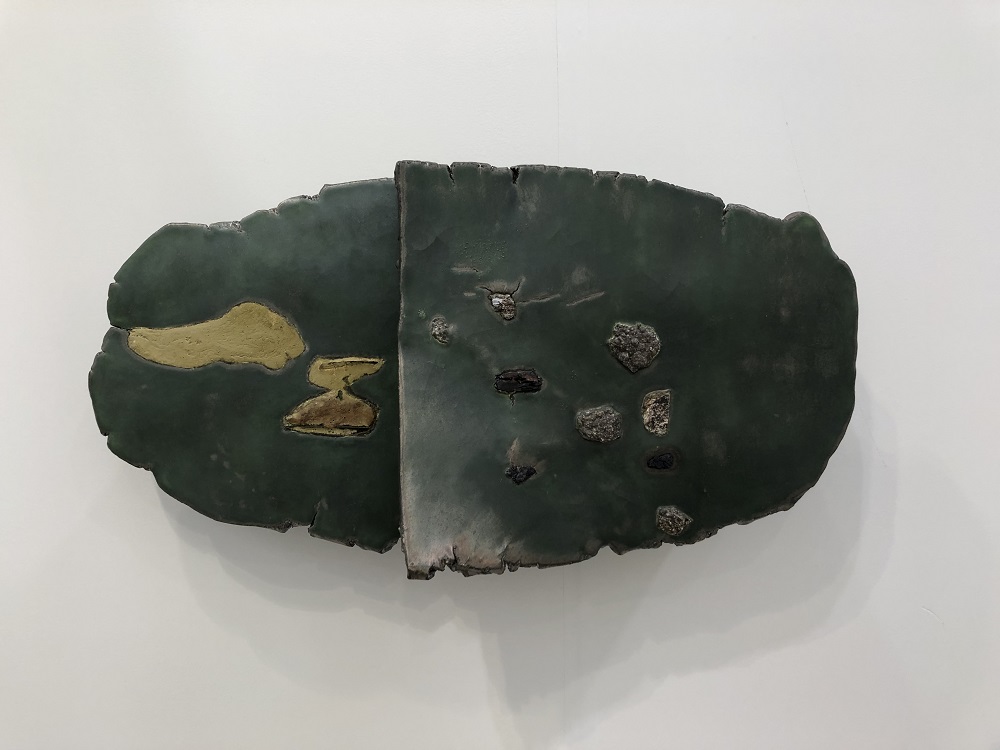
Los Angeles-based artist Liz Larner (Born 1960 in Sacramento, CA) experiments broadly with an array of sculptural materials—from fiberglass, aluminum, and stainless steel to clay, agar, and minerals—in order “to shape our awareness of [materials] by either increasing or destabilizing how we understand them,” says Larner. While already well-established as an artist, in the late 1990s Larner began to audit Ken Price’s ceramics courses at the University of Southern California. Price was a disciple of the influential artist Peter Voulkos, who taught briefly at Black Mountain College and defined a unique approach to nonutilitarian ceramics. From Price, Larner learned the basics of slab building, glazing, and firing that would inform her unique experimentations with clay.
In 2011, Larner debuted a series of large, wall-mounted ceramic slabs coated in pigmented epoxy, and more recently began a series she calls Calefaction. These works consist of slabs of clay embedded with rocks and minerals the artist gathered while making Public Jewel (2015), an outdoor sculpture commissioned for the plaza of the Byron Rogers Federal Building and U.S. Courthouse in Denver, Colorado. ii (calefaction subduction) is an earthy green, elliptical object with inset stones and minerals, composed of two overlapping “plates.” Indeed, subduction is a geological term that refers to the tectonic process when the edge of one crustal plate descends below the edge of another. Calling to mind a range of geological phenomena (including clay’s origins as earth itself) and scales of time beyond those of a single human life, Larner’s ceramics express her deeply held tenet that sculpture “is a medium that can address how our world is produced and the factors that go into forming it.”