In the 1960s, a decade known for the ascension of minimalism, postminimalism, and conceptualism in sculpture, Eva Hesse (Born 1936 in Hamburg, Germany; died 1970 in New York) was one of the most significant artists working in New York. Through the mid-to-late ’60s, Hesse used materials such as cord and rope, nets, plaster, steel, wood, papier-mâché, latex, rubber, and fiberglass to create forms that derived their structure from repetition and geometry but were executed with intuitive sensitivity. She made many important formal decisions in response to chance, gravity, randomness, and the circumstances of gallery architecture. Hesse created richly organic works that locate human tendencies, contradiction, and a dose of the surreal within the rigor of process-based conceptualism.
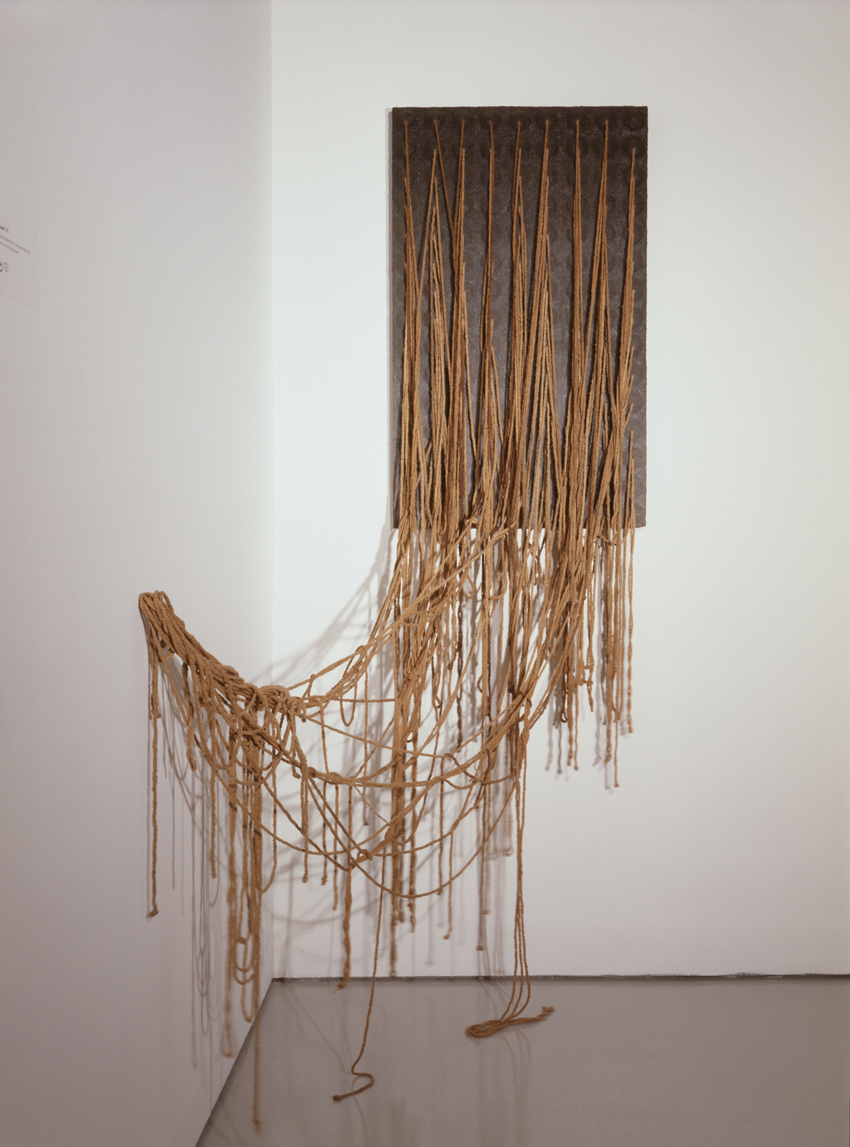
Ennead is composed of a thick, rectangular board gridded with three-dimensional papier-mâché hemispheres, with a single dyed string hanging from the center of each dome. The orderly, formulaic application of the threads devolves into an increasingly chaotic composition as they accumulate and tangle toward the floor. A few strands are affixed to the adjacent wall, cordoning off a wedge of space that becomes part of the sculpture itself. This gesture also draws the viewer’s attention to the corner of the gallery, activating this normally overlooked area. Additional material hangs to touch the floor, thus uniting three planes. “Ennead” means a group of nine, in this case referring to the nine points from which the strings extend.