In her films, photographs, sculptures, and site-specific installations, Leslie Hewitt (Born 1977 in New York) explores how photography provides access to memories of personal experience, frames understanding of the self, and shapes and preserves the collective memory of historical events. Hewitt’s distinctive visual language derives in equal measure from her instincts as an archivist—gathering and sifting through the documents—and her formal concerns, rooted in twentieth-century film theory and sculptural practice and in the longer history of still-life painting.
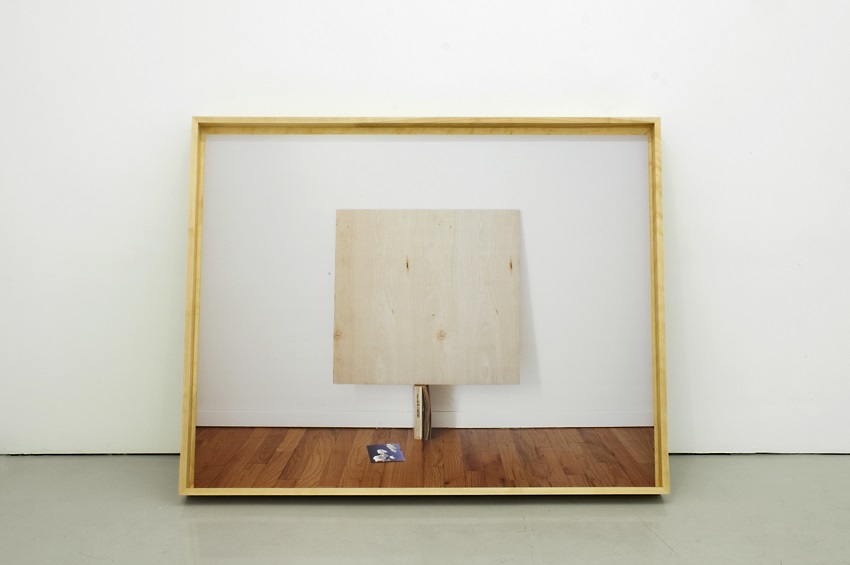
The series Blue Skies, Warm Sunlight consists of seven images, each containing a nearly sculptural composition of various objects, including books, photographs, and planks of wood. These subjects are arranged and rearranged, each work composed of an assorted set of subjects placed in varying structural forms. The work is both image and sculpture, as the large wooden frame leans against the wall, jutting out onto the gallery floor, the image/object interrupting the realm of the viewer. A mirroring occurs between the subjects in the image and the physical work itself.
Untitled (Square) contains a wood board precariously balanced on a copy of the book, The Politics of Protest, and an image of a cloudy yet blue sky strewn on the floor. Each subject implies varying relational qualities, reflecting both the personal and the political. The photograph serves as an icon of a zeitgeist, in which the subtle manipulation of subjects comes to signify a contested social memory. Within the context of this social memory, each subject is imbued with domestic and historic qualities, which viewers may assign differing interpretations. Both the viewer and Hewitt participate in a process emblematic of the molding of collective memory through iconic images, texts, and objects, a memory which, like these precarious constructions, is subject to change.