
Beyond the galleries, the ICA highlights Indigenous makers in a series of public programs and performances
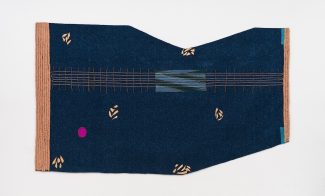
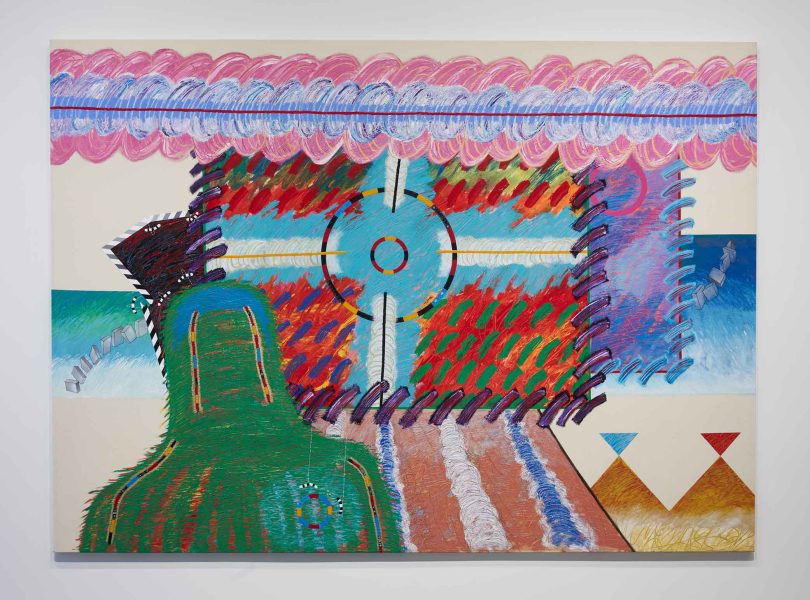
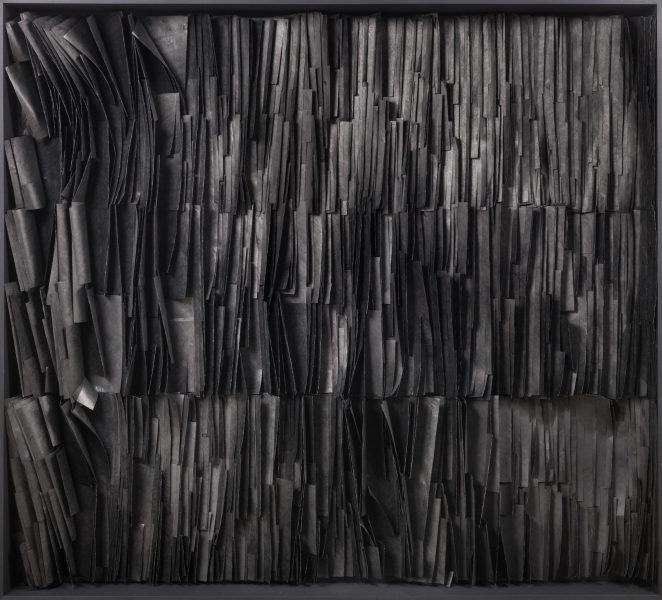
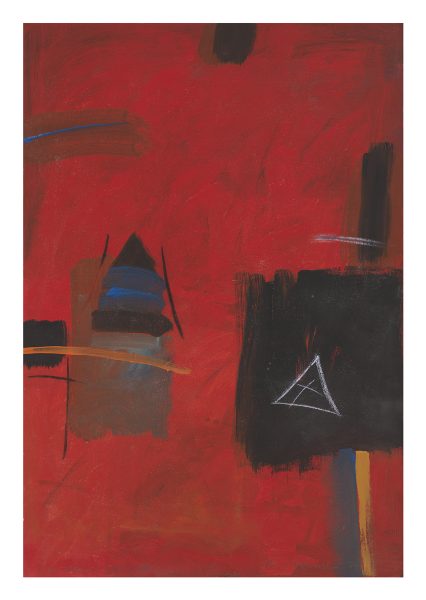
(Boston, MA—SEPTEMBER 22, 2025) On October 9, the Institute of Contemporary Art/Boston (ICA) opens An Indigenous Present, a nationally touring, thematic exhibition spanning 100 years of contemporary Indigenous art. The exhibition includes new commissions and significant works by 15 artists who use strategies of abstraction to represent personal and collective narratives, describe specific and imagined places, and build upon cultural and aesthetic traditions. Co-organized by artist Jeffrey Gibson and independent curator Jenelle Porter, the exhibition offers an expansive consideration of Indigenous art practices that highlights a continuum of elders and emerging makers, and premieres newly commissioned site-specific works by Raven Chacon, Caroline Monnet, and Anna Tsouhlarakis. An Indigenous Present emerges from Gibson and Porter’s 2023 landmark publication of the same name, which brought together work by Native North American artists exploring diverse approaches to concept, form, and medium. Their engagement with artists during the making of the book inspired this exhibition—one that demonstrates the endless variability of abstraction and its capacity to hold multiple forms and histories. An Indigenous Present debuts at the ICA, where it will be on view from October 9, 2025, through March 8, 2026, before traveling to the Frist Art Museum in Nashville (June 26—September 27, 2026) and the Frye Art Museum in Seattle (November 7, 2026—February 14, 2027).
“This exhibition is one take on the field of contemporary art and culture by Native and Indigenous makers. Some of these artists have been working for decades, and I follow in their path; others are at an earlier stage in their careers, and I see new routes and possibilities in their respective practices. Together, they are amplifying the histories that have come before them and building a new context for present and future artists,” said Gibson.
Porter added: “Since curating Jeffrey’s first solo museum exhibition at the ICA in 2013, he and I have continued to think together about ways to enlarge art histories. This exhibition is a proposal, one that explores the ways that these artists challenge the often arbitrary, historical categorizations of art by Indigenous makers.”
At the ICA, An Indigenous Present includes two new commissions that expand the exhibition beyond the galleries. An immersive sound work by Raven Chacon fills ICA’s Founders Gallery overlooking Boston Harbor. A site-specific installation by Caroline Monnet for the museum’s Sandra and Gerald Fineberg Art Wall is composed of commercial building materials that are sewn into a fractal-based composition inspired, in part, by Boston’s 600-year history of land reclamation and the ICA’s harbor location. The fractal patterns, or population “blooms,” derive from Anishinaabeg designs that, for the artist, symbolize interconnectedness, knowledge transmission, and kinship.
The exhibition unfolds across several galleries, beginning with a focus on the work of George Morrison and Mary Sully, two important forebearers whose works anchor An Indigenous Present in the first decades of the 20th century. Throughout the exhibition, works by emerging artists are positioned in dialogue with those by more established makers within five sections:
Section 1
Ground is the term for both land and a receiving surface that has been prepared for painting. It can be understood as both a generative subject and a visual motif—George Morrison and Teresa Baker evoke the land and light of their ancestral homelands through an interplay of color and form. In this section, artists merge these conceptions of “ground,” using abstraction to visualize sense memories, places, and histories. Section 1 includes artworks by Teresa Baker, Raven Chacon, Sky Hopinka, George Longfish, Caroline Monnet, George Morrison, and Mary Sully.
Section 2
This gallery includes works that use abstraction to convey expansive concepts through minimal means. It begins with Kay WalkingStick’s monumental Chief Joseph Series, from the 1970s, a work about the heroic Nez Perce chief. The 27 paintings, arranged in a grid, assert space and accumulate meaning. Other works in this section use similar strategies of repetition, with individual parts inextricable from the whole. Section 2 includes artworks by Sonya Kelliher-Combs, Dakota Mace, Kimowan Metchewais, Caroline Monnet, George Morrison, Mary Sully, and Kay WalkingStick.
Section 3
In this gallery, sound is an abstraction that flows through shape, line, and pattern. Following the theory of counterpoint—a composition of two or more voices that are both harmonically interdependent, and distinct in melody and rhythm—the works here converse with one another. Some reference stories, prayers, and singing, evoking the sounds these modes of communication require. Other works portray composers, compositions, and sound patterns. Section 3 includes artworks by Teresa Baker, Raven Chacon, Sky Hopinka, Caroline Monnet, Audie Murray, Jaune Quick-to-See Smith, and Mary Sully.
Section 4
The works in this gallery feature a range of techniques and media that artists use to collapse the distinctions between concept and material. Labored surfaces obscure shapes and images, scale equalizes object and space, and a reduced palette is used to compress space and obscure subjectivity. Section 4 includes artworks by Teresa Baker, Sonya Kelliher-Combs, George Longfish, Kimowan Metchewais, George Morrison, and Kay WalkingStick.
Section 5
In this gallery, we see artists merging idea and medium. Anna Tsouhlarakis mixes found and sourced materials in her new large-scale sculpture, and Jaune Quick-to-See Smith smokes and works the surface of a canvas as one would a hide. Both found and sourced materials come with pre-existing associations that artists coax into works that draw from personal and cultural knowledge. Section 5 includes artworks by Teresa Baker, Sonya Kelliher-Combs, Gabrielle L’Hirondelle Hill, Kimowan Metchewais, Caroline Monnet, Jaune Quick-to-See Smith, Mary Sully, Anna Tsouhlarakis, and Kay WalkingStick.
Press Preview
Media are invited to attend the press preview for An Indigenous Present on Tuesday, October 7, at 9:30am. RSVP to press@icaboston.org
Programming
Throughout the run of the exhibition, the ICA will host a series of performances, including a new, multidisciplinary commission by Raven Chacon. On October 11, visitors will experience a full day of the Pulitzer Prize-winning artist’s sound-based works and installations presented throughout the museum. Other programming throughout the run of the exhibition includes a short film series curated by artist Sky Hopinka in the museum’s Barbara Lee Family Foundation Theater; an interactive and family-friendly art installation by Mashpee-Wampanoag artist Robert Peters in the ICA Bank of America Art Lab; an Artist’s Voice conversation with artists Caroline Monnet and Sky Hopinka; and many more related events.
Artist List
Teresa Baker (Mandan/Hidatsa; born 1985 in Watford City, ND)
Raven Chacon (Diné; born 1977 at Fort Defiance, Navajo Nation)
Sky Hopinka (Ho-Chunk Nation; born 1984 in Bellingham, WA)
Sonya Kelliher-Combs (Iñupiaq and Koyukon Athabascan; born 1969 in Bethel, AK)
Gabrielle L’Hirondelle Hill (Cree and Métis; born 1979 in Comox, British Columbia)
George Longfish (Seneca and Tuscarora; born 1942 in Ohsweken, Ontario)
Dakota Mace (Diné; born 1991 in Albuquerque, NM)
Kimowan Metchewais (Cree; born 1963 in Oxbow, Saskatchewan; died 2011 in St. Paul, Alberta)
Caroline Monnet (Algonquin-Anishinaabe and French; born 1985 in Ottawa, Ontario)
George Morrison (Ojibwe; born 1919 in Chippewa City, MN; died 2000, Red Rock, MN)
Audie Murray (Cree and Métis; born 1993 in Saskatoon, Saskatchewan)
Jaune Quick-to-See Smith (citizen of the Confederated Salish and Kootenai Nation; born 1940 at St. Ignatius Mission, Flathead Reservation, MT; died 2025 in Corrales, NM)
Mary Sully (Yankton Dakota; born 1896 at Standing Rock Reservation, SD; died 1963 in Omaha, NE)
Anna Tsouhlarakis (Navajo, Creek, and Greek; born 1977 in Lawrence, KS)
Kay WalkingStick (Cherokee and Anglo; born 1935 in Syracuse, NY)
Credits
An Indigenous Present is organized by Jeffrey Gibson and Jenelle Porter, guest curators, with Erika Umali, Curator of Collections, and Max Gruber, Curatorial Assistant.
This exhibition is supported in part by Mathieu O. Gaulin, Peggy J. Koenig, Barbara H. Lloyd, Kim Sinatra, the Fotene Demoulas Fund for Curatorial Research and Publications, and an anonymous donor.
With warmest thanks, we gratefully acknowledge the generosity of the ICA’s Avant Guardian Society in making this exhibition possible.
About the ICA
Since its founding in 1936, the ICA has shared the pleasures of reflection, inspiration, imagination, and provocation that contemporary art offers with its audiences. A museum at the intersection of contemporary art and civic life, the ICA has advanced a bold vision for amplifying the artist’s voice and expanding the museum’s role as educator, incubator, and convener. Its exhibitions, performances, and educational programs provide access to the breadth and diversity of contemporary art, artists, and the creative process, inviting audiences of all ages and backgrounds to participate in the excitement of new art and ideas. The ICA is located at 25 Harbor Shore Drive, Boston, MA, 02210. The Watershed is located at 256 Marginal Street, East Boston, MA 02128. For more information, call 617-478-3100 or visit our website at icaboston.org. Follow the ICA on Facebook, Instagram, and TikTok.
Media Contact
Theresa Romualdez, press@icaboston.org