(Boston, MA—January 7, 2019) The Institute of Contemporary Art/Boston (ICA) announces its exhibition schedule for 2019. Upcoming exhibitions include Huma Bhabha’s largest survey to date, the U.S. premiere of John Akomfrah’s Purple at the ICA Watershed, and a major exhibition that considers how contemporary artists are responding to the migration, immigration, and displacement of peoples today. For more information, please contact Margaux Leonard at mleonard@icaboston.org, 617-478-3176.
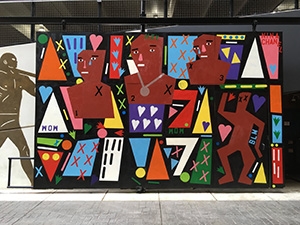
Abney_I Left Three Days Ago_350 with boarder.png

Nina Chanel Abney
January 17, 2019–March 15, 2020
Nina Chanel Abney (b. 1982, Chicago, IL) is known for weaving colorful geometric shapes, cartoons, language, and symbols into chaotic and energetic compositions. At the ICA, she will create a mural that speaks to social tensions in the digital age, including the constant stream of true and false information, the dilemma of liberal racism, and abuses of power that lead to structural inequality. This exhibition is organized by Ellen Tani, Assistant Curator.
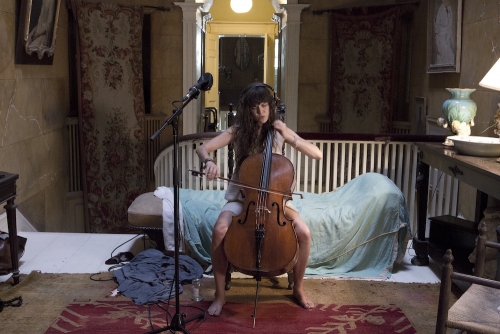
A still from The Visitors with a woman playinge cello.

Ragnar Kjartansson: The Visitors
February 13, 2019–July 28, 2019
A sentimental portrayal of friendship, love, and loss and one of the best-loved works in the ICA’s permanent collection, Ragnar Kjartansson’s (b. 1976, Reykjavik, Iceland) masterwork The Visitors (2012) is a monumental nine-channel sound and moving-image installation of a performance staged at Rokeby Farm, a historic forty-three-room estate in upstate New York. This presentation is organized by Jeffrey De Blois, Assistant Curator.
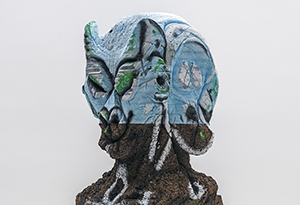
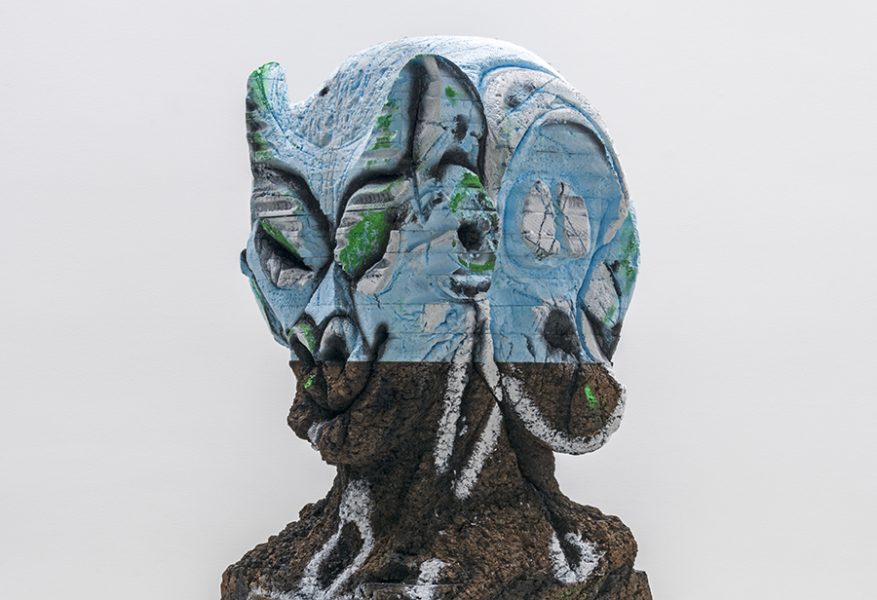
A bust by Huma Bhaba, that is gray and organic in texture, with the top covered in light blue paint.

Huma Bhabha: They Live
March 23, 2019–May 27, 2019

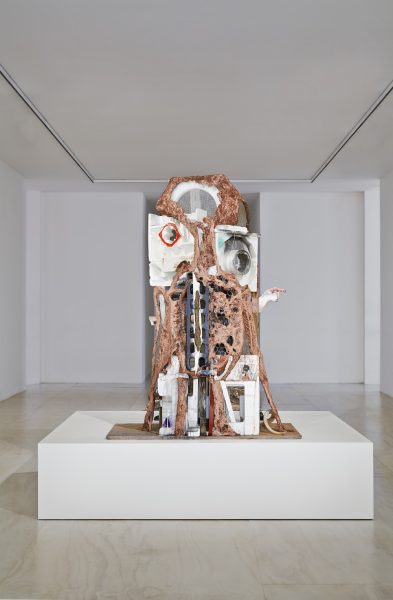
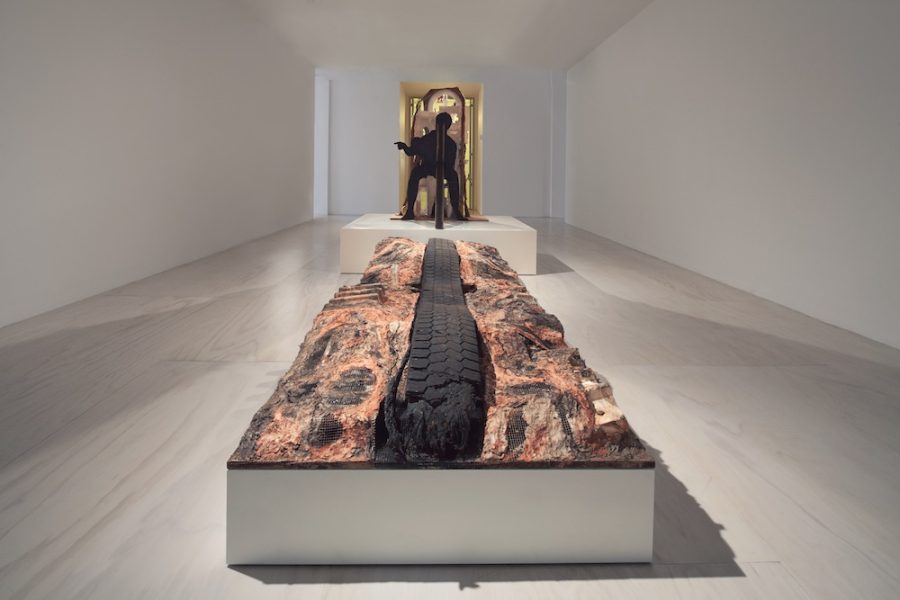
Since the early 1990s, Huma Bhabha (b. 1962, Karachi, Pakistan) has developed a distinct visual vocabulary that draws upon a wide variety of influences, including horror movies, science fiction, ancient artifacts, religious reliquary, and modernist sculpture. The largest survey of the artist’s work to date, Huma Bhabha: They Live encompasses sculpture, drawing, and photography, with a special focus on Bhabha’s engagement with the human figure. Best known for her sculptures, Bhabha uses a diverse array of natural, industrial, and found materials to make compelling works that engage the arts and histories of diverse cultures. Her work transcends a singular time and place, instead creating an exploration of what she describes as the “eternal concerns” found across all cultures: war, colonialism, displacement, and memories of home. Huma Bhabha: They Live will also include drawings, photographs, and prints spanning the past two decades, as well as new works made on the occasion of this exhibition. It will be accompanied by a lushly illustrated scholarly publication. This exhibition is organized by Eva Respini, Barbara Lee Chief Curator
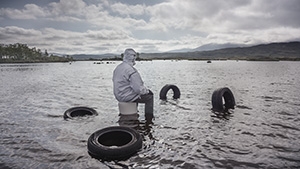
A person in a light windbreaker sits on a bucket in silvery water among abandoned tires.

John Akomfrah: Purple
May 26, 2019–September 2, 2019
At the ICA Watershed

Co-commissioned by the ICA and making its U.S. premiere at the ICA Watershed, Purple is an immersive six-channel video installation by the acclaimed artist and filmmaker John Akomfrah (b. 1957, Accra, Ghana). Akomfrah draws from hundreds of hours of archival footage, combining it with newly shot film and a hypnotic sound score to address themes related to the implications of climate change across the planet and its effects on human communities, biodiversity, and the wilderness. Sited in the Watershed’s industrial building, Purple resonates deeply with the Watershed’s harbor location and its proximity to the current and historical maritime industries of the East Boston Shipyard and Marina. Symphonic in scale and divided into five interwoven movements, the film features various disappearing ecological landscapes, from the hinterlands of Alaska and the desolate environments of Greenland to the Tahitian Peninsula and the volcanic Marquesas Islands in the South Pacific. Purple conveys the complex and fragile interrelation of human and non-human life with a sense of poetic gravity that registers the vulnerability of living in precarious environments. John Akomfrah: Purple is organized by Eva Respini, Barbara Lee Chief Curator, with Cara Kuball, Curatorial Project Manager.
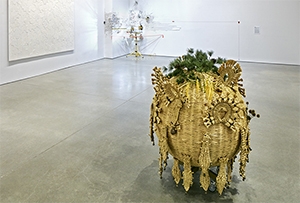
An organic sculpture round in shape.

Less is a bore: Maximalist Art & Design
June 26, 2019–September 22, 2019

Less is a bore: Maximalist Art & Design is a multigenerational survey of strategies of pattern and decoration in art and design. Borrowing its ethos from Robert Venturi’s infamous retort to Mies van der Rohe’s modernist edict “less is more,” this exhibition includes art works that privilege decoration, patterning, and maximalism over modernism’s reductive “ornament as crime” philosophy. Less is a bore: Maximalist Art & Design investigates the impulse toward ornamentation, pattern painting, and decorative modes as a persistent strategy, one that can be deployed to critique, subvert, and transform accepted histories and trajectories related to craft and design, feminism, queerness and gender, beauty and taste, camouflage and masquerade, multiculturalism and globalism, among others. The exhibition surveys a field of interdisciplinary creative production, from art to design, that proves such strategies are multivalent and exceedingly adaptable methods to make art works that play fast and loose with “high” and “low,” and that reference ideas, forms and symbols at once personal and political, contemporary and historical, local and global. This exhibition is organized by Jenelle Porter, guest curator, with Jeffrey De Blois, Assistant Curator.
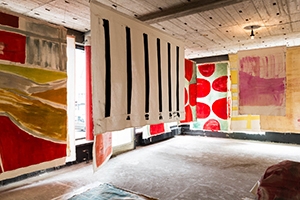
Hanging unstretched paintings with light coming through them.

Vivian Suter
August 21, 2019–January 5, 2020

Vivian Suter (b. 1949, Buenos Aires, Argentina) works in close partnership with the natural environment surrounding her home and studio in Panajachel, Guatemala. The artist’s first Boston exhibition will feature a single installation filling the galleries with a canopy of color and shapes evocative of the lush setting. Her method often involves moving her canvases between the indoors and outdoors and exposing them to the climate in order to allow nature to comingle with her broad swaths of painted, vivid color. The mud and rain, light through the trees, and animals in the forest work in concert with Suter’s gestural compositions, which are inspired by the surrounding vegetation and landscape. Her installation of layered and suspended canvases invites visitors to discover her unique dialogue with the imagined and natural worlds. This exhibition is organized by Ruth Erickson, Mannion Family Curator.
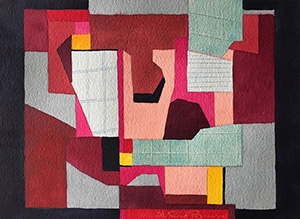
Poznanski_untitled_300 with padding.png

2019 James and Audrey Foster Prize
August 21, 2019–January 5, 2020
The 2019 installment of the ICA’s biannual James and Audrey Foster Prize exhibition highlighting the work of Boston-area artists will feature four individuals: Rashin Fahandej (b. 1978, Shiraz, Iran), Josephine Halvorson (b. 1981, Brewster, MA), Lavaughan Jenkins (b. 1976, Boston, MA), and Helga Roht Poznanski (b. 1926, Tartu, Estonia). This intergenerational group of artists works across media, including painting, sculpture, film, and video, to explore questions of place, portraiture, and belonging. Their unique and exceptional work demonstrates the breadth and ecology of contemporary art practices in Boston. First established in 1999, the James and Audrey Foster Prize (formerly the ICA Artist Prize) is central to the ICA’s efforts to nurture and recognize local artists, showcase exceptional artwork, and support a thriving local arts scene. This exhibition is organized by Ruth Erickson, Mannion Family Curator.
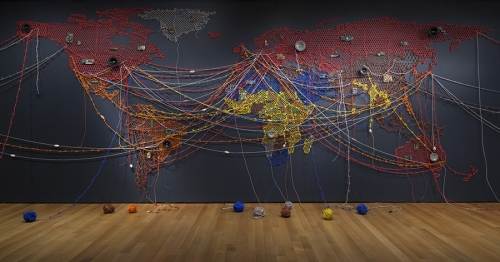
ART541806_Kallat MoMA Art Resource_300.jpg

When Home Won’t Let You Stay: Migration through Contemporary Art
October 23, 2019–January 26, 2020
When Home Won’t Let You Stay: Migration through Contemporary Art considers how contemporary artists are responding to the migration, immigration, and displacement of peoples today. We are currently witnessing the highest levels of movement on record—the United Nations estimates that one out of every seven people in the world is an international or internal migrant who moves by choice or by force, with great success or great struggle. When Home Won’t Let You Stay borrows its title from a poem by Warsan Shire, a Somali-British poet who gives voice to the experiences of refugees. Through artworks made since 2000 by twenty artists from more than a dozen countries—such as Colombia, Cuba, France, India, Iraq, Mexico, Morocco, Nigeria, Palestine, South Korea, the United Kingdom, and the United States—this exhibition highlights diverse artistic responses to migration ranging from personal accounts to poetic meditations, and features a range of mediums, including sculpture, installation, painting, and video. Artists in the exhibition include Kader Attia, Tania Bruguera, Isaac Julien, Hayv Kahraman, Reena Saini Kallat, Richard Mosse, Carlos Motta, Yinka Shonibare, Xaviera Simmons, and Do-Ho Suh, among others. A fully illustrated catalogue accompanies the exhibition, with an essay by Eva Respini and Ruth Erickson and texts by prominent scholars Aruna D’Souza, Okwui Enwezor, Thomas Keenan, Peggy Levitt, and Uday Singh Mehta, among others. This exhibition is organized by Ruth Erickson, Mannion Family Curator, and Eva Respini, Barbara Lee Chief Curator, with Ellen Tani, Assistant Curator.

About the ICA
Since its founding in 1936, the Institute of Contemporary Art/Boston has shared the pleasures of reflection, inspiration, imagination, and provocation that contemporary art offers with audiences in Boston and beyond. Its innovative exhibitions, performances, and educational programs provide access to contemporary art, artists, and the creative process, inviting audiences of all ages and backgrounds to participate in the excitement of new art and ideas. Spanning two locations across Boston Harbor, the ICA offers year-round programming at its iconic building in Boston’s Seaport and seasonal programming (May-September) at the Watershed, part of a functioning East Boston shipyard.

The ICA is located at 25 Harbor Shore Drive, Boston, MA, 02210. The Watershed is located at 256 Marginal Street, East Boston, MA 02128. For more information, call 617-478-3100 or visit our website at icaboston.org. Follow the ICA at Facebook, Twitter, and Instagram.


Nina Chanel Abney is supported, in part, by Jean-François and Nathalie Ducrest.

Ragnar Kjartansson: The Visitors is a Gift of Graham and Ann Gund to Institute of Contemporary Art, Boston, Solomon R. Guggenheim Museum, New York, and Gund Gallery at Kenyon College.

Support for this presentation is generously provided by Kate and Charles Brizius, James and Audrey Foster, Jodi and Hal Hess, Kristen and Kent Lucken, and Tristin and Martin Mannion. 

Major support for Huma Bhabha: They Live is provided by The Andy Warhol Foundation for the Visual Arts.


Huma Bhabha: They Live is generously sponsored by Max Mara.

Additional support is generously provided by Karen and Brian Conway, Steve Corkin and Dan Maddalena, Fotene Demoulas and Tom Coté, Cynthia and John Reed, and Charlotte and Herbert S. Wagner III. 

Support for the Huma Bhabha: They Live publication provided by Salon 94.

John Akomfrah: Purple has been commissioned by the Barbican, London and co-commissioned by Bildmuseet Umeå, Sweden, TBA21-Academy, The Institute of Contemporary Art/Boston, Museu Coleção Berardo, Lisbon and Garage Museum of Contemporary Art, Moscow.

Free Admission to the ICA Watershed is made possible by the generosity of Alan and Vivien Hassenfeld and the Hassenfeld Family Foundation.

The ICA Watershed is supported by Fund for the Arts, a public art program of the New England Foundation for the Arts.

The 2019 James and Audrey Foster Prize exhibition and prize are generously endowed by James and Audrey Foster.

Nina Chanel Abney, I Left Three Days Ago, 2016. Acrylic and spray paint, Library Street Collective, Detroit, Michigan. Courtesy of Nina Chanel Abney studio. © Nina Chanel Abney. | Ragnar Kjartansson, The Visitors, 2012. Nine-channel HD video projection, 64 minutes, Edition 4 of 6, Gift of Graham Gund to the Institute of Contemporary Art, Boston and the Gund Gallery, Kenyon College. Courtesy of the artist, Luhring Augustine, New York, and i8 Gallery, Reykjavik. © Ragnar Kjartansson | Huma Bhahba, Four Nights of a Dreamer (detail), 2018. Cork, Styrofoam, acrylic, oil stick, and lacquered wood pedestal, 74 ½ × 36 × 36 inches (189.2 × 91.4 × 91.4 cm). Courtesy the artist and Salon 94, New York. © Huma Bhabha | John Akomfrah, Purple (still), 2017. Six-channel HD color video installation with 15.1 surround sound; 62 minutes. Courtesy Lisson Gallery. © Smoking Dogs Films | Haegue Yang, The Intermediate — Inceptive Sphere, 2016. Artificial straw, steel stand, powder coating, artificial plants, artificial fruits, plastic twine, Indian bells, and caster. 53 ⅛ x 45 ¼ inches (134.9 x 114.9 x 114.9 cm). General Acquisition Fund. Photo by Charles Mayer. © Haegue Yang | Vivian Suter, Nisyros (Vivian’s bed), 2016–17. Installation view, Kassel, Germany, for Documenta 14. © Vivian Suter | Helga Roht Poznanski, Untitled, c. 2018. Watercolor on paper, 17 x 24 inches. Courtesy the artist. © Helga Roht Poznanski | Woven Chronicle, 2011–2016. Installation view, Insecurities: Tracing Displacement and Shelter, October 1, 2016 – January 22, 2017, The Museum of Modern Art, New York. Photo by Jonathan Muzikar.© The Museum of Modern Art/Licensed by SCALA / Art Resource, NY
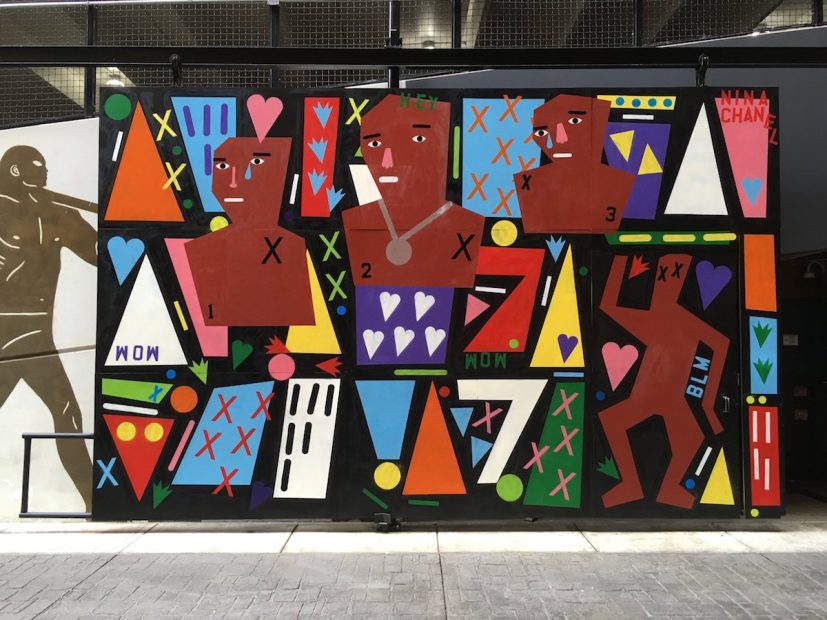
(Boston, MA—December 18, 2018)  On Jan. 17, Chicago-born artist Nina Chanel Abney debuts a monumental, site-specific mural at the Institute of Contemporary Art/Boston (ICA). Abney, born in 1982, is at the forefront of a generation of young artists that is reenergizing narrative figurative painting. A skillful storyteller, Abney masterfully weaves colorful geometric shapes, language, and symbols into energetic and chaotic scenes that address the complex social dynamics of today. Created for the museum’s Sandra and Gerald Fineberg Art Wall, the new work—Abney’s first presentation in Boston—features vibrant vinyl cut-outs of various colors, forms, and sizes collaged into a visually compelling storyboard. Referencing what it means to “level the playing field” politically and socioeconomically, a bold black-and-white checkerboard pattern grounds the various characters, or “players,” in Abney’s narrative. On view through March 15, 2020, Abney’s installation is organized by Ellen Tani, Assistant Curator.

“Abney is a fantastic painter: creating vibrant, pulsing colossal compositions of figures, words, and shapes and using a brilliantly colored palette to express and dissect the notion of self in a dynamic and fraught world,” said Jill Medvedow, the ICA’s Ellen Matilda Poss Director. “The Sandra and Gerald Fineberg Art Wall, located in the museum’s glass-enclosed lobby, is an open, free and public space for visitors to encounter Abney’s art.”

“Nina is inspired by the power of public messaging—whether billboards, graffiti, current events, or digital information—as such, her approach is intuitive, improvisational, and responsive to social climate. The ICA installation draws on her current practice of creating site-specific public murals whose vibrant colors, recognizable imagery, and balance of chaos and order invite the viewer to both consume and consider their content,” said Tani.

Abney’s artistic practice is grounded in painting but spans a variety of forms, from fashion collaborations to playground surfaces to large-scale public murals. Often working improvisationally in spray paint, she makes brightly-colored compositions that channel the velocity of information cycles and viral content. Abney renders what comes across her radar through social media, popular culture, and the internet as a visual language of signs and icons that is both playful and challenging, and evokes feelings of stimulation and fatigue. Responding to the seemingly inescapable and weighty conditions of suffering that permeate much of the news today, Abney describes her artwork as “easy to swallow and hard to digest.”

The ICA’s Sandra and Gerald Fineberg Art Wall is dedicated to site-specific works by leading contemporary artists, commissioned annually.
 

About the artist

Nina Chanel Abney (b. 1982 in Chicago) earned her Bachelor of Fine Arts from Augustana College, IL in 2004, where she studied computer science and studio art. She earned a Master of Fine Arts at Parsons School of Design in 2007. Abney’s first solo exhibition, Nina Chanel Abney: Royal Flush, opened at the Nasher Museum of Art at Duke University in 2018. Her work is held in private and public collections including the Brooklyn Museum, The Rubell Family Collection, Bronx Museum, and the Burger Collection, Hong Kong. She currently lives in New York.
 

About the ICA

Since its founding in 1936, the Institute of Contemporary Art/Boston has shared the pleasures of reflection, inspiration, imagination, and provocation that contemporary art offers with audiences in Boston and beyond. Its innovative exhibitions, performances, and educational programs provide access to contemporary art, artists, and the creative process, inviting audiences of all ages and backgrounds to participate in the excitement of new art and ideas. Spanning two locations across Boston Harbor, the ICA offers year-round programming at its iconic building in Boston’s Seaport and seasonal programming (May-September) at the Watershed, part of a functioning East Boston shipyard.

The ICA is located at 25 Harbor Shore Drive, Boston, MA, 02210. The Watershed is located at 256 Marginal Street, East Boston, MA 02128. For more information, call 617-478-3100 or visit our website at icaboston.org. Follow the ICA at Facebook, Twitter, and Instagram.


Support provided, in part, by Jean-François and Nathalie Ducrest.

Largest survey of the artist’s work to date spans 20 years, encompassing sculpture, drawing, and photography

(Boston, MA—December 3, 2018) The Institute of Contemporary Art/Boston (ICA) presents Huma Bhabha: They Live, the largest survey of the artist’s work to date. Spanning over two decades of Bhabha’s work, this major exhibition features sculpture, drawing, and photography, and considers the artist’s engagement with the human figure. Best known for her sculptures, Bhabha uses a wide variety of materials ranging from clay, Styrofoam, bronze, bricks, wood, construction materials, and other found material, to make compelling works that engage the arts and histories of diverse cultures. Tending towards the grotesque, Bhabha’s sculptures feature hybrid bodies or figures that appear human, animal, or alien, and evoke life in a post-apocalyptic or ruined landscape. Her work transcends a singular time and place, instead creating an exploration of what the artist describes as the “eternal concerns” found across all cultures and temporalities: war, colonialism, displacement, and memories of home. On view March 23 through May 27, 2019, Huma Bhabha: They Live is organized by Eva Respini, Barbara Lee Chief Curator.

“Huma Bhabha’s quiet authority, persevering vision, and commanding work distinguish her as an exceptional artist with a unique and haunting artistic voice. This overdue exhibition offers visitors the opportunity to experience and understand the sweep and power of Huma Bhabha,” said Jill Medvedow, the ICA’s Ellen Matilda Poss Director.  

While Bhabha works primarily in sculpture, she also makes drawings, photographs, and prints. Her drawings in pastel and ink incorporate a skillful blend of figuration and abstraction. In many of these works, she has composed an image, whether a face or body part, and persistently traced and retraced the lines within the composition, which result in haunting, blurred effects. Bhabha’s reworked photographs, many taken by the artist in her native Karachi, are layered with her own markmaking, referencing the documentary photography tradition with a personal and fantastical dimension.  

“The artist’s hand and a certain primacy of her interactions with materials are central to Bhabha’s practice. She deploys a distinctive mixture of additive and reductive methods to create her sculptures, with intuition driving her process, resulting in works that appear unfinished,” said Respini. “With their raw beauty, haunting presence, and narrative associations, Bhabha’s works adamantly broadcast the mutable, volatile, and expressive capacities of the figure.”

Huma Bhabha: They Live presents nearly 50 of the artist’s most significant artworks, including several of her newest works, such as the large scale bronze Benaam, recently featured on the rooftop of the Metropolitan Museum of Art in New York. The exhibition’s organization is not chronological, but rather influenced by the three foundational figural modes seen throughout the history of sculpture: standing, sitting, or reclining, in which Bhabha often positions her figures, or characters, as she calls them. The first room, for instance, exhibits a range of media and strategies Bhabha has employed over the years, from her early wall-mounted masks to sculptural figures composed of both found and traditional materials, introducing viewers to the breadth of her practice. Each of the subsequent galleries demonstrates how she engages the figure, nodding to art historical traditions—ancient Egyptian figures to Greek kouros—along with pop cultural sensibilities.
 

Exhibition Highlights

Bhabha’s work is a synthesis of her varied interests in art, history, film, television, and current events. Representing a refreshing and novel take on the figure, her characters embody hybridity: they are often intersex, multiethnic, and sometimes embody both animal and human characteristics. They are also hybrid in their making, composed of myriad combinations from organic to manufactured materials.

  • The Orientalist (2007) is perhaps the most imposing and archetypal of Bhabha’s seated figures. Originally made from Styrofoam, wood, metal, wire, and clay, and then cast in bronze, the figure seems to have been wasting away at the moment it was cast, its masklike face both haunted and impassive. Bhabha has referred to the figure as a cyborg, and it takes on hybridity in its cultural references as well. The face reminded the artist of Oscar Wilde’s portrait of Dorian Gray, while the title references, in part, Edward Said’s groundbreaking 1978 text Orientalism. With this work, she questions the ethics of colonialism and evokes a deep suspicion of who, as Bhabha remarks, “speaks with authority about foreign cultures.”
  • Bhabha’s recent experiments with cork—now a signature material for the artist—and often combined with materials such as Styrofoam, have produced an astonishing and potent body of upright totemic figures, including Castle of the Daughter (2016) and Waiting for Another Game (2018). These figures appear to represent gods, goddesses, demons, or monsters, unearthed from a previous time or presaging a coming era.
  • One of Bhabha’s most iconic sculptures, Benaam (2018), evokes the rich history of reclining sculptural forms and also the largest scale the artist has worked in. She produced the first version of this reclining figure in 2002 as a memorial to the victims in Afghanistan and Iraq of the wars that began in 2001. Bhabha has since created this work in several iterations. The larger-than-life Benaam depicts a prostrate figured with a trailing tail made of clay and swathed in a black garbage bag. The sheet of plastic suggests a praying or corpse-like form, but could also be read as a burka or body bag.
  • A series of photogravures, Reconstructions (2007), highlight Bhabha’s fertile practice of drawing and overpainting on photographs. For this series, she photographed stalled construction sites in Karachi and the desert landscapes on the city’s outskirts. After making black-and-white enlargements of the photographs, Bhabha drew on them with India ink. The arrested construction sites are newly reborn as foundations or plinths for sculptures that may have existed once, and the landscapes as a whole serve as a pedestal for her imagined monuments. In these hybrid works on paper, the artist subverts photography’s documentary role, instead creating elegiac ideas of ruin.
     

Catalogue

Huma Bhabha: They Live is accompanied by a lushly illustrated scholarly publication, co-published with Yale University Press, featuring essays that investigate Bhabha’s prolific and multidisciplinary output as well as her historical and cultural reference points. The volume is edited by Eva Respini, with contributions by Carter E. Foster, Ed Halter, Jessica Hong, Shanay Jhaveri, Respini, and a conversation between Huma Bhabha and artist Sterling Ruby.
 

Exhibition Press Preview

Friday, Mar 22, 9:30–11:00 AM

Media are invited to attend a tour of the exhibition led by Respini. RSVP to Margaux Leonard, mleonard@icaboston.org
 

The Artist’s Voice: Huma Bhabha

Thursday, May 2, 7 PM

Huma Bhabha’s monumental sculptures at the ICA reflect the diversity of influences in her art, including horror films, science-fiction, and modernist sculpture. This rich and complex visual vocabulary enables her to create timely and stirring works. She states, “I make what I want to make while feeling a responsibility to bear witness to what is happening in the world.”  Hear more about what drives Bhabha’s artistic practice in this engaging conversation between the artist and Eva Respini, the ICA’s Barbara Lee Chief Curator.

About the artist

Huma Bhabha (b. 1962, Karachi, Pakistan) came to the United States in 1981 to attend University. She holds a BFA from the Rhode Island School of Design and earned an MFA from Columbia University in 1987. She lives and works in Poughkeepsie, New York. She has exhibited widely nationally and internationally, including solo exhibitions at The Contemporary Austin (2018); the Metropolitan Museum of Art, New York (2018); the David Roberts Art Foundation, London, United Kingdom (2017); Collezione Maramotti, Reggio Emilia, Italy (2012); MoMA PS1 (2012); and the Aspen Art Museum in Aspen (2011).  Her work has been included in various group exhibitions such as All the World’s Futures, Venice Biennale (2015) and exhibitions at the Museum of Contemporary Art Cleveland; WIELS Contemporary Art Centre, Brussels; Whitney Museum of American Art, New York; The Hepworth Wakefield, Yorkshire, United Kingdom; Stedelijk Museum Bureau, Amsterdam; and the New Museum, New York. Her works are included in prominent museum collections, including the Metropolitan Museum of Art, New York; The Museum of Modern Art, New York; New York Public Library; Whitney Museum of American Art, New York; Nerman Museum of Contemporary Art, Kansas; Saatchi Gallery, London; David Roberts Art Foundation, London; and the Centre Pompidou, Paris.

About the ICA

Since its founding in 1936, the Institute of Contemporary Art/Boston has shared the pleasures of reflection, inspiration, imagination, and provocation that contemporary art offers with audiences in Boston and beyond. Its innovative exhibitions, performances, and educational programs provide access to contemporary art, artists, and the creative process, inviting audiences of all ages and backgrounds to participate in the excitement of new art and ideas. Spanning two locations across Boston Harbor, the ICA offers year-round programming at its iconic building in Boston’s Seaport and seasonal programming (May-September) at the Watershed, part of a functioning East Boston shipyard. 

The ICA is located at 25 Harbor Shore Drive, Boston, MA, 02210. The Watershed is located at 256 Marginal Street, East Boston, MA 02128. For more information, call 617-478-3100 or visit our website at icaboston.org. Follow the ICA at Facebook, Twitter, and Instagram.


Major support for Huma Bhabha: They Live is provided by The Andy Warhol Foundation for the Visual Arts.

Huma Bhabha: They Live is generously sponsored by Max Mara.

This project is supported in part by the National Endowment for the Arts.

National Endowment for the Arts logo

Additional support is generously provided by Karen and Brian Conway, Steve Corkin and Dan Maddalena, Fotene Demoulas and Tom Coté, Cynthia and John Reed, and Charlotte and Herbert S. Wagner III. 

Support for the Huma Bhabha: They Live publication provided by Salon 94.


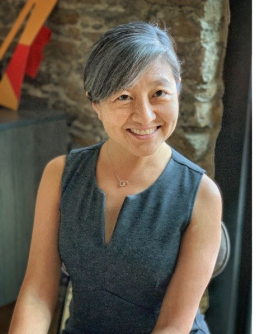
(Boston, MA—Nov. 27, 2018) Jill Medvedow, Ellen Matilda Poss Director of the Institute of Contemporary Art/Boston (ICA), announced today the appointment of Tsugumi Maki to serve as the museum’s Chief Operating Officer. Maki comes to the ICA from the Davis Museum at Wellesley College, where she served as Associate Director of Operations and Collections Management since March 2015. In her new role at the ICA, Maki will strengthen the institutional infrastructure of the museum—staff, facility, business development and data systems—to achieve goals, leverage opportunities, and prepare for the decade ahead. She starts at the ICA on Jan. 7, 2019.

A headshot of Tsugumi Maki.

“Tsugumi’s expertise in strategic museum management along with her background in project management and collaboration make her ideally suited for the range of responsibilities she will take on as our new Chief Operating Officer. We are thrilled to be welcoming her to the ICA,” said Medvedow.

At the Davis Museum, Maki supported all collections and operational activities of the museum, including driving long-term planning, managing large-scale projects, and overseeing daily operations. As Associate Director of Operations and Collections Management, she played an important role in unveiling a major reinstallation of the Davis Museum’s permanent collections galleries in 2016. Prior to her time at the Davis, Maki served in many positions at the Museum of Fine Arts, Boston (MFA) during her nearly 18-year tenure. As Head of Gallery Planning and Installations, Maki was instrumental in the organization of the Art of the Americas Wing and the new contemporary galleries. Maki earned her master’s degree at Tufts University and a bachelor’s degree at Ithaca College.

About the ICA

Since its founding in 1936, the Institute of Contemporary Art/Boston has shared the pleasures of reflection, inspiration, imagination, and provocation that contemporary art offers with audiences in Boston and beyond. Its innovative exhibitions, performances, and educational programs provide access to contemporary art, artists, and the creative process, inviting audiences of all ages and backgrounds to participate in the excitement of new art and ideas. Spanning two locations across Boston Harbor, the ICA offers year-round programming at its iconic building in Boston’s Seaport and seasonal programming (May-September) at the Watershed, part of a functioning East Boston shipyard.

The ICA is located at 25 Harbor Shore Drive, Boston, MA, 02210. The Watershed is located at 256 Marginal Street, East Boston, MA 02128. For more information, call 617-478-3100 or visit our website at icaboston.org. Follow the ICA at Facebook, Twitter, and Instagram.