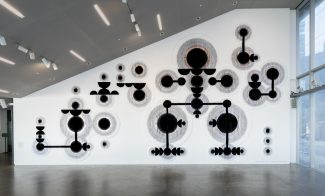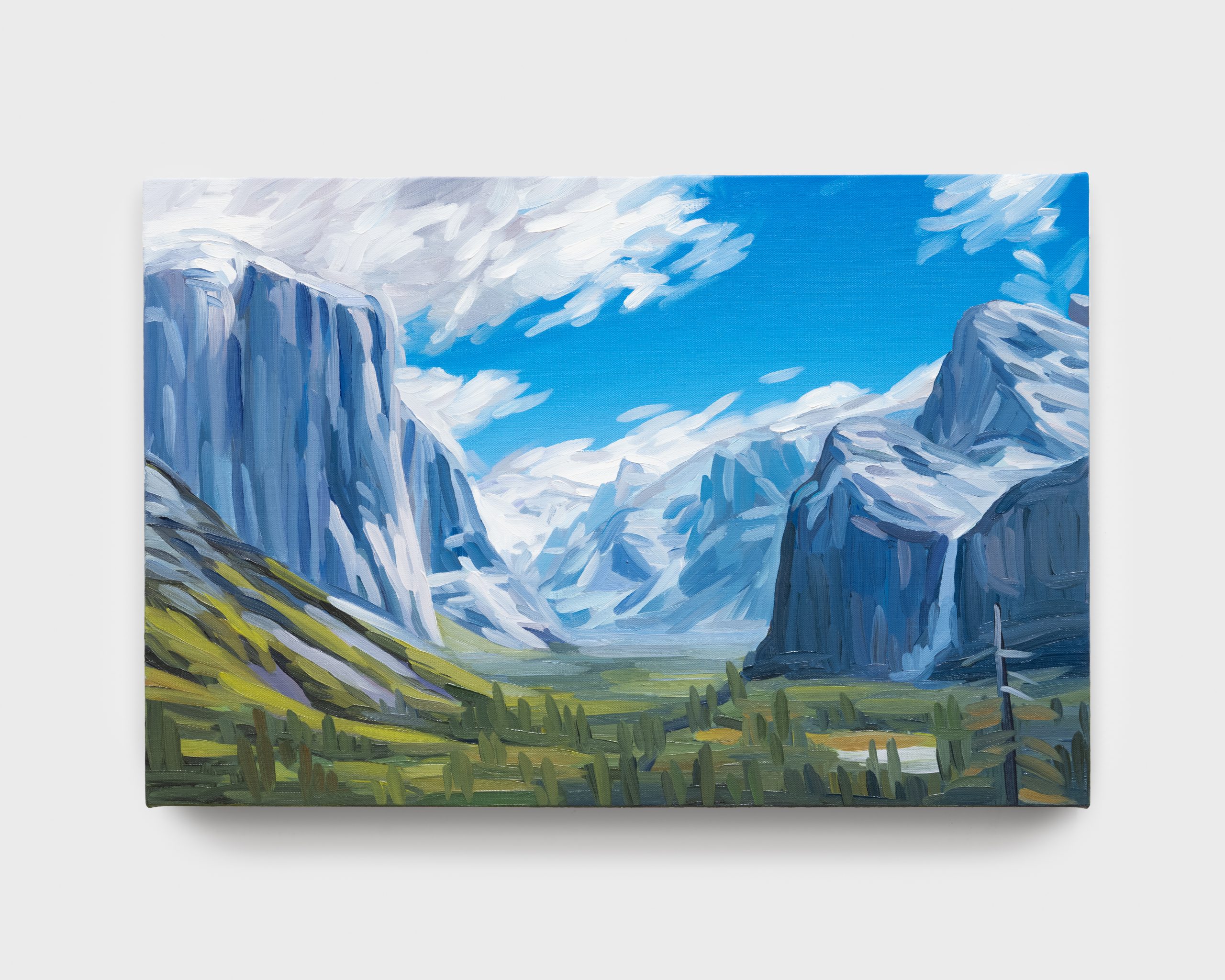
Jeffrey De Blois: We’ve talked a lot about your steadfast commitment to reconsidering American landscape painting, which you’ve been doing for quite some time, given our evolving relationship with the land itself. From your perspective, why is it important to reevaluate the genre today?
Cynthia Daignault: At its core, landscape painting explores the deepest questions of being. How do humans exist in the world? These questions are always relevant. However, they feel especially urgent right now. Climate change. Wildfires. Overdevelopment. AI. Data centers. Public land. Virtual reality. The singularity. Our relationship to the earth has never been more tenuous and debatable. Change has never been so swift. And our experience of the external world as our central place of being is also shifting.
Painting has a unique ability to take on these mind/body questions since they are reflected in the structure of painting itself. Vision and gesture. Conceptual ideas and physical materiality. Our essential duality is mirrored in the dualistic nature of painting. It’s a medium that at its core is built to explore what we see, how we see, and how we understand our place in the world.
JD: Why do you consider Tunnel View to be one of the most important landscapes in art, history, and mythologies of American identity?
CD: Yosemite, in its formalism, its history, and its art history, contains the entire story of the American relationship to landscape. The discovery of gold in California and the rush to mine it in the 19th century brought hundreds of thousands of people to the state. This influx of settlers hastened the decimation of Native and animal populations across the state, often referred to by contemporary historians as the California Genocide. The new settlers who came to California were fortune hunters, and a small group of individuals saw an opportunity in Yosemite for tourism and began to heavily promote the area. They packaged Yosemite around the false ideas of Manifest Destiny—the idea that the American West was a raw, empty, wild, and unpeopled land, rich with possibility and wealth. Early tourists arrived in the wake of the genocide, so they often did encounter those landscapes as wild and empty, even though they had in fact been previously cultivated, tended, and filled with human and animal life. And the pace of extraction was such that untouched land was a myth by the turn of the 20th century.
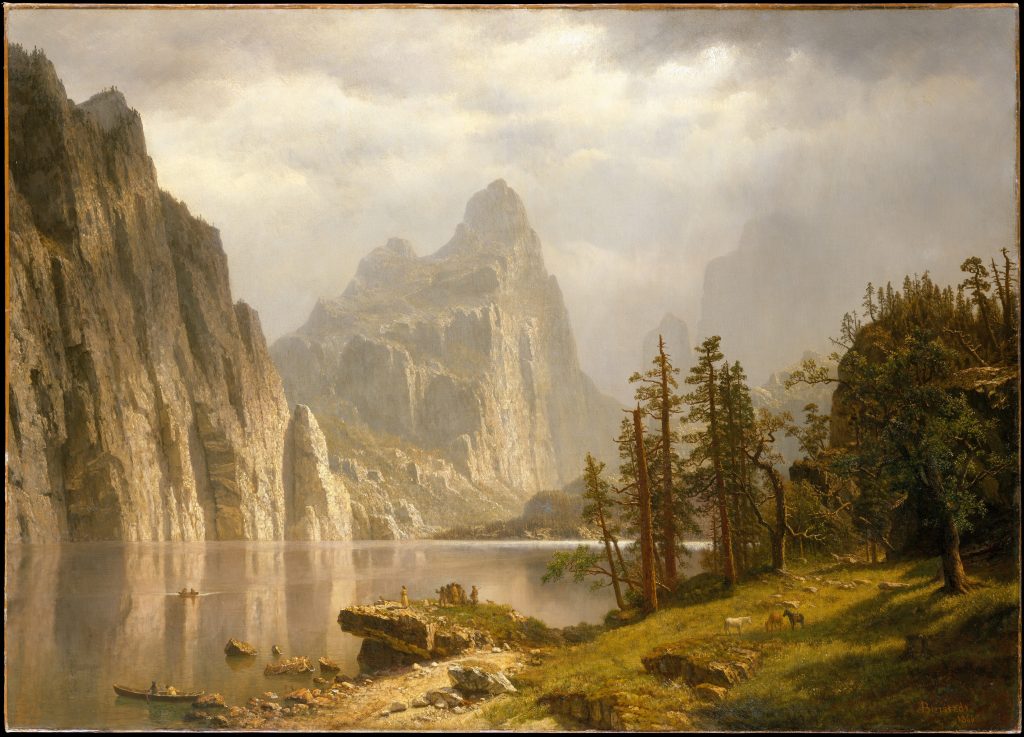
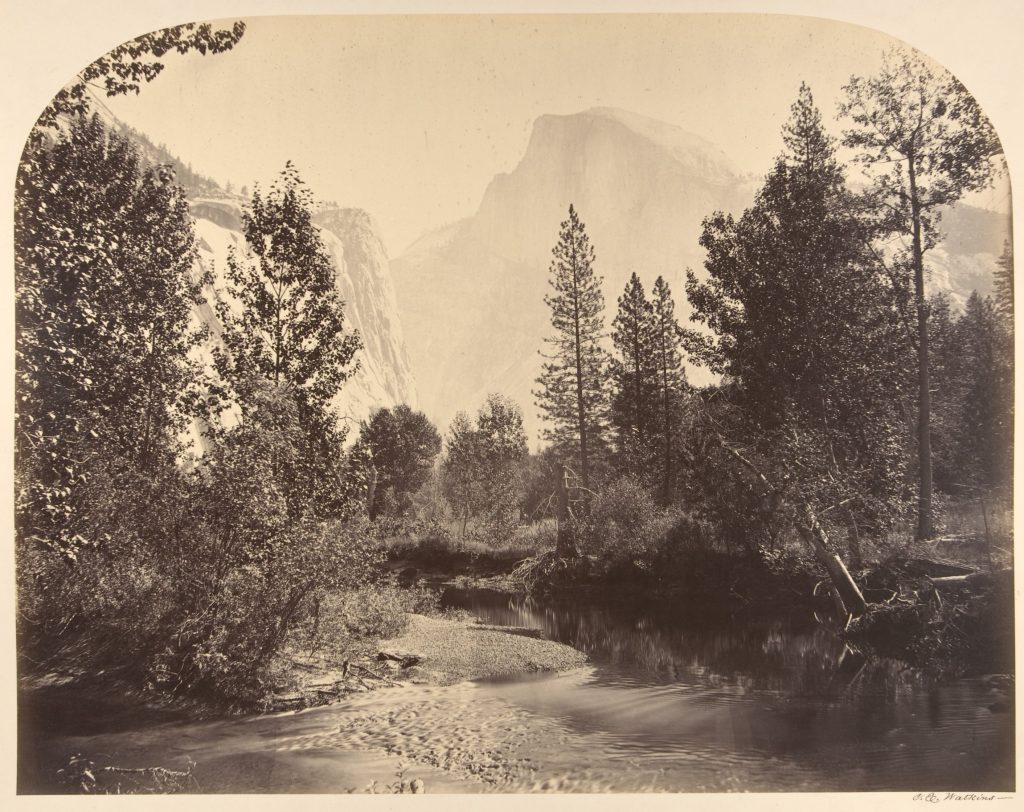
Artists and photographers were among the first visitors to the park. Painters like Albert Bierstadt (1830-1902) and photographers like Carleton Watkins (1829-1916) came in those very first years of tourism. Their images and artworks of Yosemite became the visual representations of Manifest Destiny. Their works spread that fantasy of a raw and expansive West, and those artworks specifically convinced Abraham Lincoln, eager for a symbol of hope and rebuilding in the wake of the Civil War, to sign the first national protections for any land into law. The entire idea of public land as we know it began in Yosemite. And years later, the work of naturalist John Muir to enshrine those protections led to a national park system as we have today.
Tunnel View is the first panoramic view a visitor sees when entering Yosemite from the south. There is a large stone overlook built to frame the view where people can park, get out, and capture the quintessential picture of the valley. It is also the view you see from the aptly named artist and inspiration point hikes. I don’t think there is any site in the country with images more iconic than Yosemite, and specifically Tunnel View. Nor do I think any other place signals “American Landscape” more.
Yosemite and its peaks recur across history as the landscape of American exceptionalism in The Hudson River School paintings, in the early photographs of Carleton Watkins, in the work of Ansel Adams, in Free Solo (2018), and in the entire suite of Apple OS X names and desktops. Yosemite has a truly iconic status in the culture. There are whole websites devoted to where and when to stand to recreate the famous shots of Yosemite, and people camp out by the hundreds every day to do so.
I don’t think this symbolic status is just a factor of history or coincidence. I think it’s formal. Yosemite is a series of granite peaks. The granite makes the site feel like a series of monuments. Like a natural, American Rome. And the landscape is a series of valleys between these peaks. So, rather than images centered on a singular mountain, pictures in the park often depict the negative space of a valley, a portal through which we move, from something to something. That transcendence is integral to the land and the embodiment of idealism. The idyllic receding distance that we move toward. Yosemite contains all the beauty of what this sublime land “America” could become, along with all the stark American histories of capitalism, greed, plunder, bloodshed, extraction, and death.
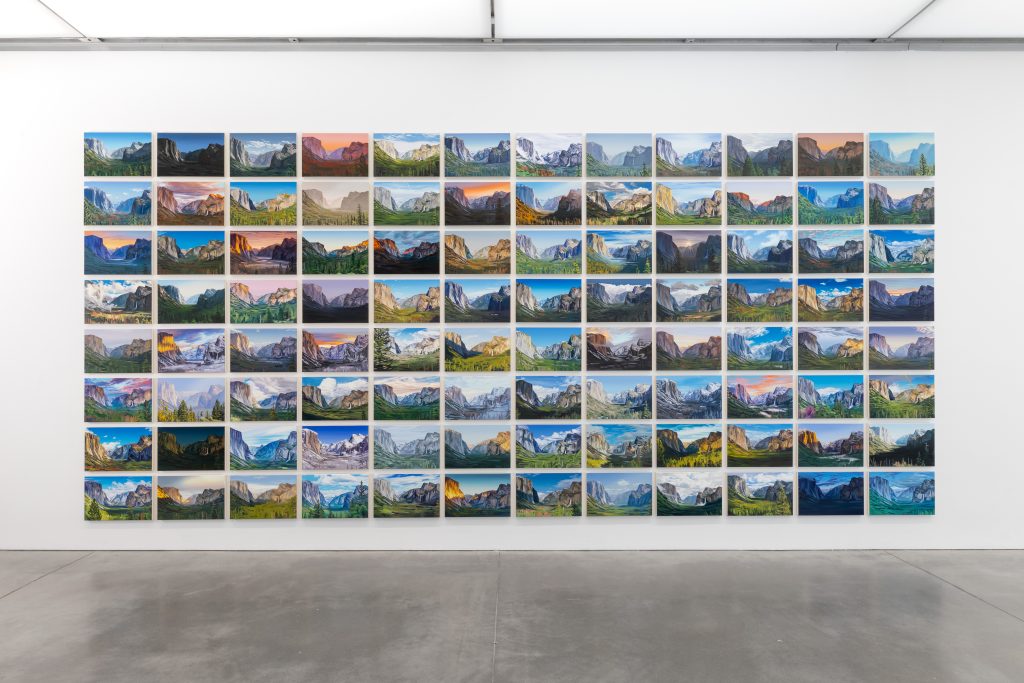
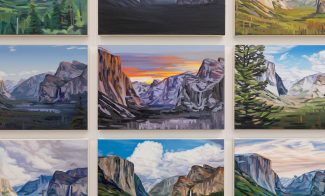
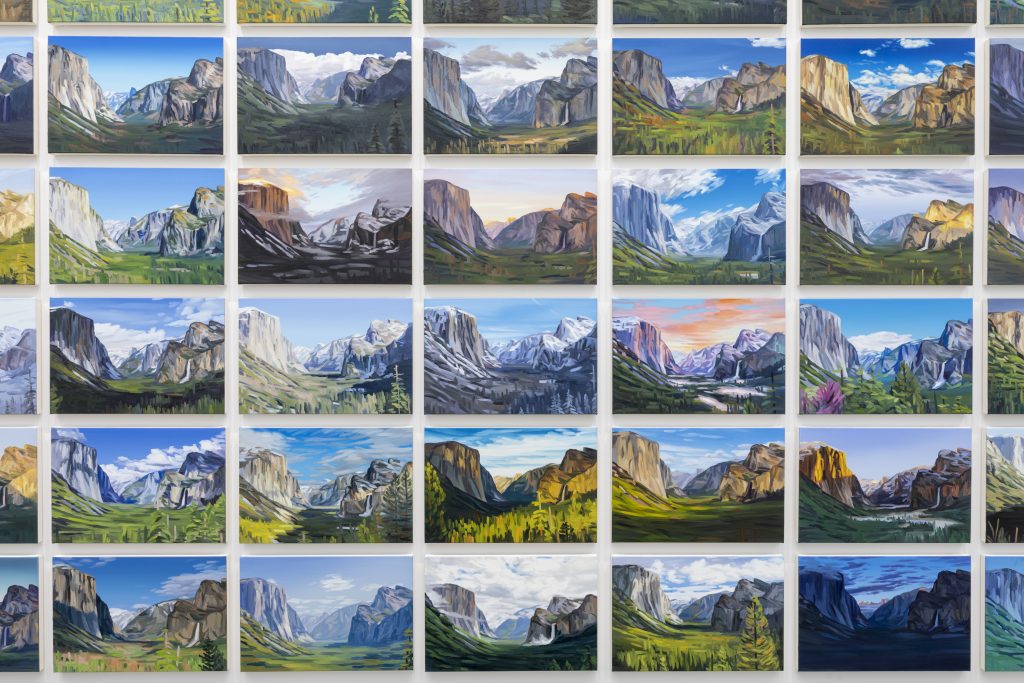
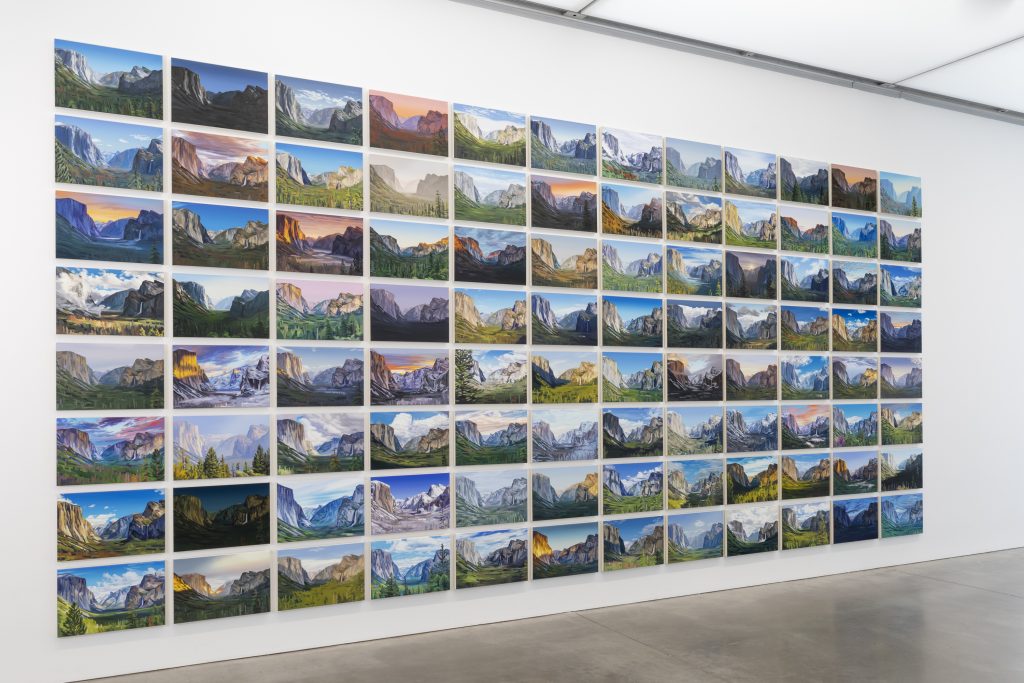
JD: You are very clear that the ninety-six canvases that constitute Valley are both paintings of a landscape, and paintings of an archive of digital photographs of the landscape. Can you explain the distinction? What do you see as the relationship between painting and photography from the perspective of how we relate to images today?
CD: I like to say that I paint “from life.” However, in 2026, life is lived in two spheres: the physical and the virtual. I don’t know about you, but most days I spend more time on my phone, or feed, or scroll, or email, or Netflix than I do outside in a forest. I see more pictures of trees than actual trees, by a factor of a hundred. That virtual environment is around us at all times. It sits on top of our world, like Pokémon GO or Meta Glasses or Flock LPR cameras, as a scrim of data points resting on top of the earth. And that virtual world also sits beside our world, in a parallel, placeless space, like Tron (1982) or The Matrix (1999) or Second Life, where we live entire lives in infinite, wall-less chat rooms or comment feeds.
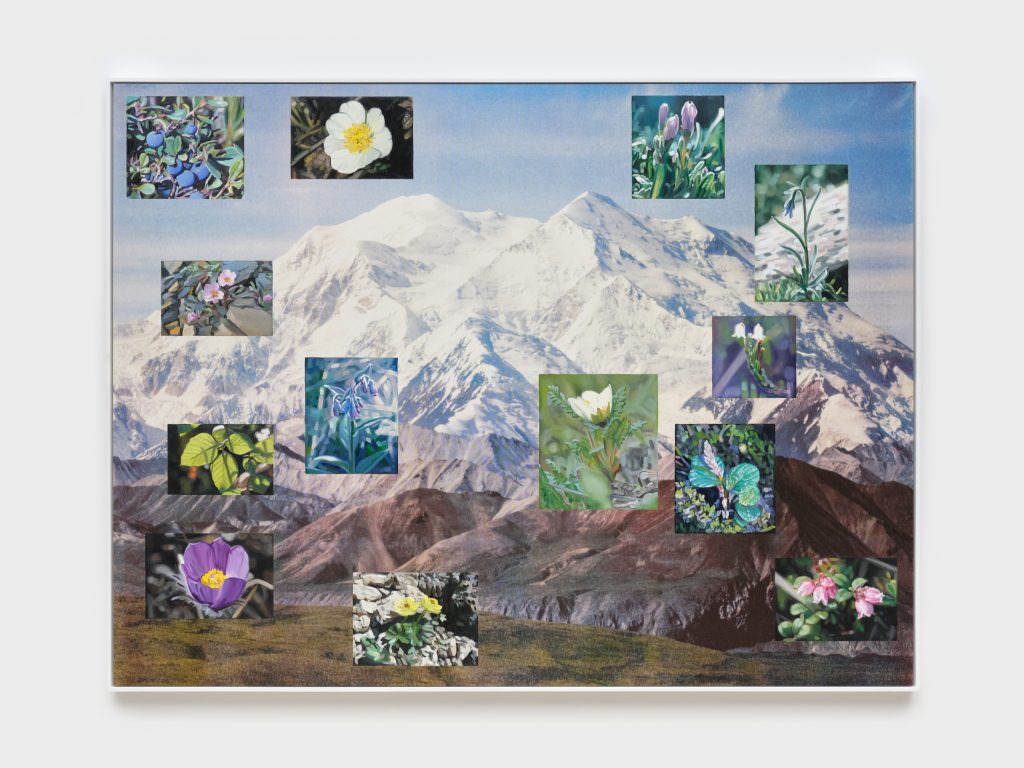
So, when I think about painting from life in 2026, it can’t just be packing up my travel easel and sitting on the banks of the Seine to paint the lunches on the grass. I have to enter the metaverse and figure out how to represent that digital landscape as well. So, Valley is a landscape painting of Yosemite, a real place in California. That’s the signifier. But it’s also a landscape painting of the virtual landscape of Yosemite. The media of and about Yosemite. Maybe that’s the signified. The metadata. The index. The idea. The myth. The shadow self. It’s both a painting of the place and of its avatar.
JD: How is vernacular figurative painting, and landscape painting in general, the “base unit” for your more minimalist or conceptually driven artistic practice? Can you detail the operation of “feed[ing] the history of painting into conceptualism—and feed[ing] conceptualism back into the history of painting,” as you have described it to me?
CD: When you’re making a piece like this, there are hundreds of choices that must be made before the painting begins. What size will the canvases be? How many paintings will the piece have? What will the image(s) be? What will the subject be? One of the biggest sets of choices involves the “how” of the paintings. Once I’ve picked an image, I still have to decide how to render it. The idea that an artist has just one way they paint isn’t quite accurate. Most of us can work across any number of rendering techniques and lean one way or another (looser, tighter, more impressionistic, more realistic) depending on the intentions for the piece. Even within your own given style, there is a pretty wide range of rendering approaches.
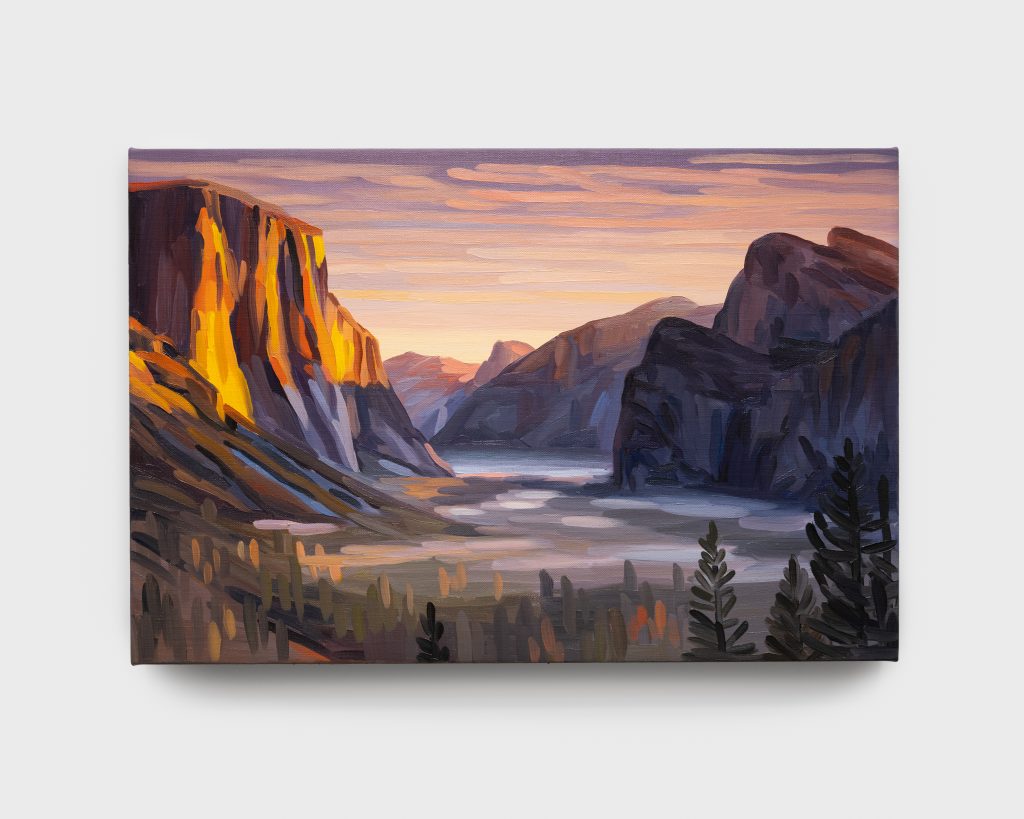
For Valley, in order to finish the piece in under a year, I had to have a rendering approach that I could reliably complete a painting in one day. Eight to twelve hours of painting in a single sitting. That dictates a looser, less-exacting style. It necessitates working alla prima, or wet-on-wet. And I wanted the paintings to have that look and feel of en plein air landscape works. When you’re painting outside, you have light, weather, bugs, and time to contend with. So, you tend to work quickly and loosely to capture the scene as an impression. Much like a camera with a six-hour shutter speed.
That kind of loose and wet-on-wet painting from life is vernacular painting. Every day across this country, tens of thousands of people are setting up easels outside or in their homes to render those kinds of landscapes. A lot of my own education comes from that art world. I never got an MFA. Instead, after undergrad, I spent seven years going several times a week to a neighborhood figure-drawing atelier, drawing from the nude model with a group of middle-aged, mostly retired hobbyists. I have a tremendous love and respect for the idea of painting as a practice, and you find that equally in the art world and in that world of hobbyists and regional artists. If you do a search with “painting Tunnel View,” there are thousands of results on Google, Instagram, Etsy, and eBay. And that stock quality is why I chose it for this piece. There is nothing genius or transcendent about making a single painting of Yosemite. That’s the point. It’s the work of a daily painting practice. Methodical and devotional.
In many ways, I am still that kind of vernacular painter, someone who structures my time and marks the days of my life with painting, the same way some people pray or do yoga or garden or meditate. But I am also equally a student of art history who fell in love with minimalism and conceptual art. My work exists as the genesis between those two selves. I always loved the idea that painting could be the building block of a monumental serial work of conceptual art. Like Carl Andre stacking bricks. Or Felix Gonzalez-Torres piling candies. Except the building block is a painting. I’m not the only one who works like that either. I relate deeply to artists like Byron Kim or Rob Pruitt or On Kawara who similarly use paintings to build an expansive environment. Bringing those postminimalist practices (installation, immersion, monumentality, malleability, duration) into painting, and bringing painting into those practices, is at the core of how I understand contemporary painting.
For me, that wasn’t simply an idea. I had political motivations for working that way as well. I’m a product of Gen X and the 1990s, and I have always bristled at the genius myth. Working the way I do, building larger works through modest, incremental gestures, I’m negating some of the market value of a singular painting in favor of the value of the aggregate. The practice denies the genius myth, as the single pieces are unheroic. Any heroism comes instead from the devotional act of time. I am creating a space where the power of art comes not from some trickle-down notion of genius or talent but from a ground up idea of labor and sacrifice. The work is populist at its core. That duality between the modest part and monumental whole is metaphoric for a life. The mundane prosaic nature of any singular day relative to the power and beauty in the entire arc of a human life.
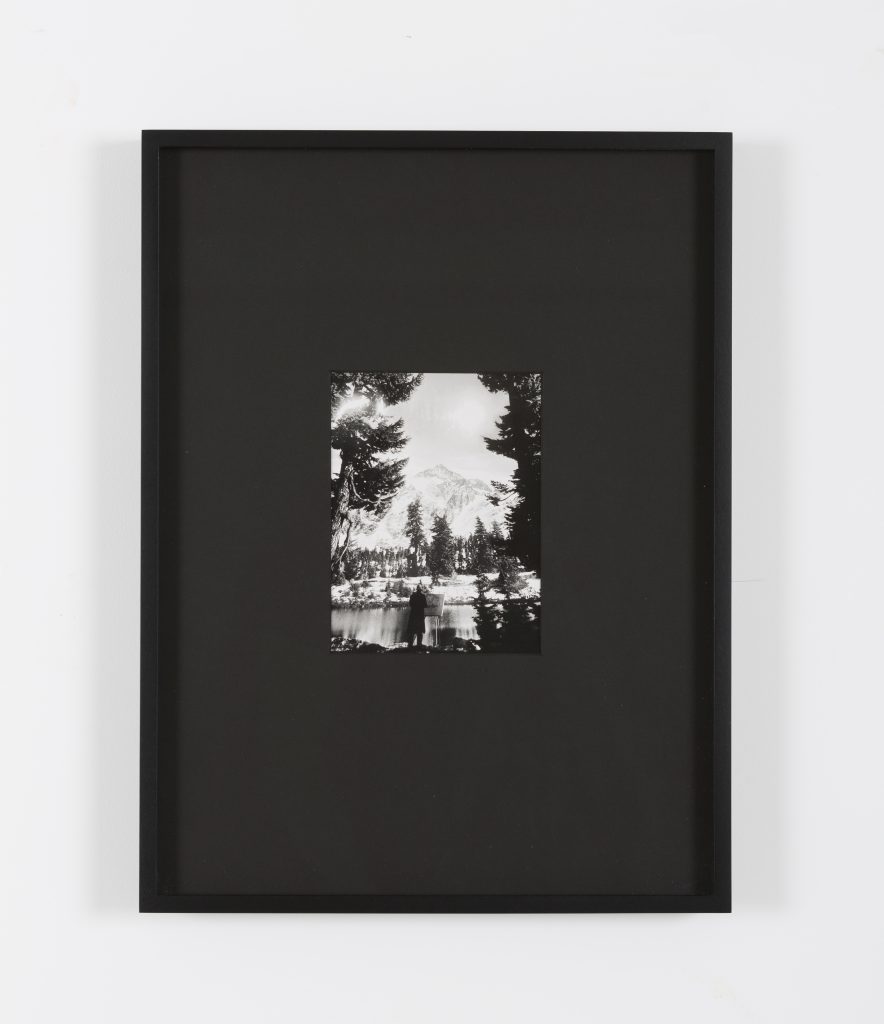
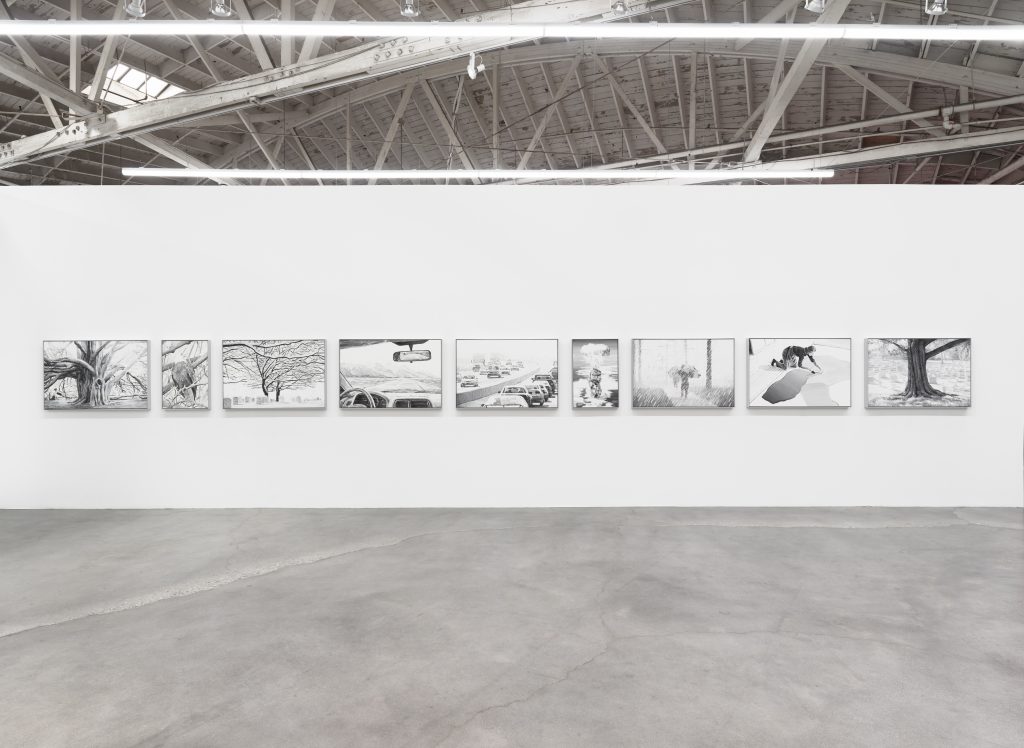
JD: How does At Picture Lake (The Painter), an intimately scaled black-and-white photograph appended to the installation, fit into your conception of vernacular painting? What does it unlock potentially for the viewer about how the installation of serial paintings functions?
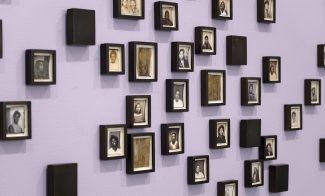
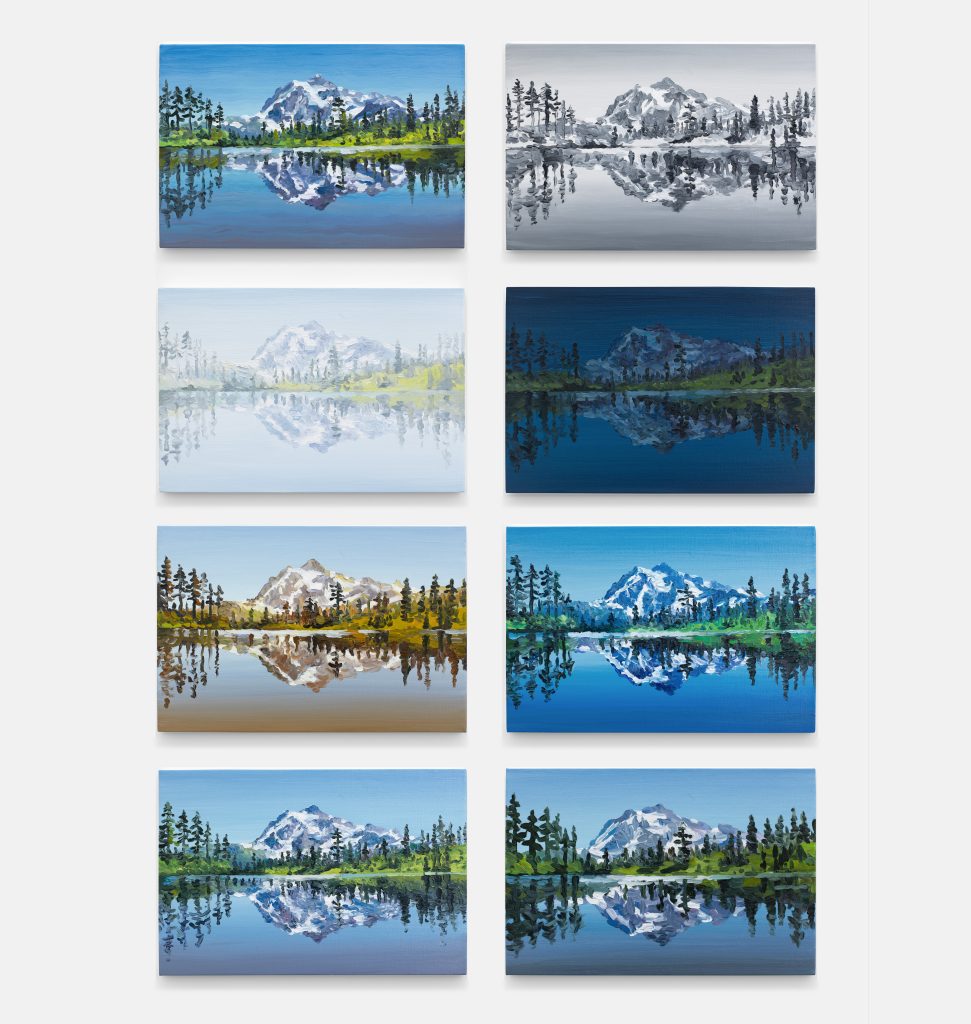
CD: I made that photograph in 2017 for the show Picture Lake at The Sunday Painter gallery in London. Yet I really felt that it fit with this work and could act as a kind of cipher for Valley. I found the source photo in a lot of historical photos I bought from a collector when I was researching the work What Happened (2018). The photo shows Mount Shuksan and Picture Lake in Washington state. Picture Lake got its name from park rangers who felt the lake frames the perfect photograph: a singular mountain peak behind a reflective lake. Park staff installed a tripod stand on a dock in front of the lake where you can set up your camera and get the quintessential photo of an American western landscape. It’s one of the most pervasive and recognizable landscape pictures across the internet, even though the park itself gets very few visitors (and even though it’s ironically often mislabeled as Yosemite). In the found photo, a painter is set up to do a plein air painting of Picture Lake. Here is our 19th-century fantasy of the landscape artist working from life. However, there is also behind the lens a photographer on-site to capture the artist, who most likely constructed the entire scene for the photograph. So, here too then is our mediated life, where we live life both for and in front of some future audience on the other side of the camera. The influencer life. The photographer making the photograph of the artist making the painting. The artist. The photographer. The canvas. The photograph. And the oscillating relationship between photography and painting.
To make At Picture Lake (The Artist), I brought that found eight-by-ten photo to Washington and set it up on the dock with the tripod stand, so that it was facing the sky. The reflection you see on the photograph is the sunlight from North Cascades National Park, reflecting off the gloss of the photo paper. I took an iPhone photo of that moment when I was sitting on the dock in front of Picture Lake, and made a traditional negative and gelatin silver print from my photo. To me, the work depicts a mise en abyme: two mirrors facing each other, reflecting into infinity. This is a fractal. Or the ouroboros, the snake eating its own tail. It is the feedback loop of our contemporary mediated lives. And it’s the infinite reflective relationship between painting and photography. Oh, the meta of it all.
JD: How does American art made through repetitive practices of seriality, like Andy Warhol’s Shadows (1978–79) for example, relate to what you perceive to be a duality between capitalism and spirituality inherent to American identity?
CD: There are historical artworks that you think about when you’re planning a work. For Valley, I was thinking about the Hudson River School and Ansel Adams and so many of the direct Yosemite referents for the work. Conceptually, I was also thinking a lot about minimalism and Carl Andre or Sol LeWitt or Ed Ruscha. Works like LeWitt’s Variations of Incomplete Open Cubes (1974). But sometimes after you start working, there are other historical works that hit you so hard, works that you might not have considered at all during the planning stage. Right after I started painting Valley, all I could think was that I was making my own answer to Warhol’s Shadows. There’s actually a funny painter joke like that. In school, we used to say that you can’t make a representational painting that Gerhard Richter hasn’t already made. That in the middle of working, or after you finish, you’ll inevitably find some Richter painting you’ve never seen that looks exactly like yours, only better. Warhol’s a bit like that too; you run back into him without planning it all the time. He covered a lot of ground.
Warhol’s work, and that piece specifically, is so fundamentally American. Shadows contains the dualistic nature of the American heart: capitalist and spiritualist. Industrialist and religious pilgrim. Serial work at its core is talking to capitalism. Cranking out a succession of repetitive objects is Ford’s factory, or the Amazon fulfillment center, or “time to make the donuts.” The unit is the commodity. The nature of commodity changes with the phases of capitalism, and so too it changes in the artworks that address these themes. For Carl Andre or Richard Serra, in mid-century capitalism, the base units were post-industrialist byproducts: bricks or steel sheets, for example. For Felix Gonzalez-Torres or Jason Rhoades, in the nineties post-globalist capitalism, the base units were cheap imports: candies, beads, and extension cords. For me, in late-stage technocracy, the base unit is the digital array, data sets, and the JPEGs of the image-saturated world in which we find ourselves in 2026.
So, on one hand, the serial is the exploration of capitalism. Yet the serial is also a spiritual practice through the daily rituals of prayer and devotion. Americans came to this country as industrialists, but also as spiritualists. Pilgrim. Quaker. Shaker. While the serial object can be viewed as a commodity, it is equally about the devotional act of prayer or labor. Labor in the Shaker sense, that to labor is to give glory to God. The daily act of prayer. The daily act of meditation. In Shadows, Warhol was giving us the form of mid-century advertising. The mass, repetitive, and screenprinted poster from the subway platform or side of the bus. Yet he is also depicting transcendental spiritual repetition. This piece, like other well-known serial works, was commissioned by Dia Art Foundation, whose cofounders Heiner Friedrich and Philippa de Menil (Fariha al-Jerrahi) are devout Sufi Muslims. And in Sufism, like most religions, repetition is a core practice to get closer to God.
I think what I find so moving about Shadows is how Warhol utilizes the form of capitalist advertising to create a spiritual experience. Though the serial invokes both commodity and prayer, the end result of that work is an incredible spiritual experience. My work is similar in its goals. The image streams we encounter every day—the feeds and the scrolls—are nihilist. Their only organizing principle is to sell. Sell more product. Create more micro-communities to sell more product. Collect consumer data to sell more product. And yet, run those forms through the slow and deliberate process of painting, and I can reclaim those image streams to create meaning and purpose. Just as Warhol used the language of advertising to create a slow mediation on life, on time, and on (disco) death, I am using the language of computing to create a slow meditation on life, on time, and on (Earth) death.
JD: In what ways do Valley’s tonal variations negotiate different registers of time—from day-to-day changes in light and atmosphere to geological time scales? How does the image of a valley repeated seemingly endlessly become a vessel for ideas about technology, philosophy, the environment, and so much else?
CD: Wow, that is a big question. Let me approach it by talking about some of the different ways of reading Valley.
One could read Valley as a portrayal of time. The paintings depict different seasons and different times of day at the site. All the infinite patterns of light and color comprise the identity of Yosemite. A portrait in the cubist sense. Multifaceted. Or like Sol LeWitt’s cubes. In that read, the piece is a metaphor for a life. The days of our life, the seasons of our life, the way that time passes and our experience of physical space is inseparable from our place on a timeline.
Or one could read Valley as a metaphor for an image database. A Google image search. A stock photo library. An Instagram hashtag. For me, this gets into questions about how digital photography controls how we know the world. We come to know the earth through photography more than through direct lived experience. There is a hive-mind, crowd-sourced process through which we form our understanding of our environment today. We’re all carrying a camera at all times. And we’ve surrounded ourselves with more and more cameras every day. LPRs. Body cams. Satellites. Drones. Doorbell cams. All these separate agents are gathering data that gets organized into massive image arrays and data sets. One thing that is easy to forget about image libraries is that they are built from photographs, not the world, meaning we’re not constructing an understanding of a site from direct lived experience but rather from mediated experience. As David Hockney loved to say, photographs look like photographs, not like the world. Photography is a very specific form of abstraction that flattens depth and color. So, when we’re on Instagram or Google or Getty Images, we’re forming an understanding of a place like Yosemite based on a very narrow and reductive set of data points. Valley is a portrait of that kind of image array.
Or one could see the piece as a meditation on artificial intelligence. I’ve been making this kind of serial work for over fifteen years. And fifteen years ago, I talked a lot about the above, about image databases. Yet, making this work in 2026, it was the first time that I was thinking more about AI and less about those kinds of social media image arrays. First, I was so struck that this might be the only and last moment when I could even make this piece. In a few years, AI-generated images will be so mixed in with digital images, and so undetectable, that one won’t be able to separate AI images from photos taken with a camera, which do still have some kind of indexical relationship to the physical world. Second, I found myself thinking about how an image grid like this is a depiction of AI “food.” This is the kind of data set we would feed into the language learning model to teach it “Yosemite.” What is so interesting to me is that we didn’t train AI on the world because AI doesn’t have human eyes or human senses (yet). It can’t see or experience a site like Yosemite as we do with all our senses holistically. We trained AI on digital images, which, as I was getting into before, are translations and distortions of the world. So, ask AI to generate a picture of Yosemite and you’re not getting Yosemite but a synthesis of digital images of Yosemite—so many of which themselves were manipulated or fabricated in Photoshop. Imagine a photographer popping a better cloud into Tunnel View. You can’t tell the difference at a glance, but it might be a cloud type or a shadow or a color that you would never see in real life at Tunnel View. The image array includes all those distortions and exaggerations and lies. The images that trained AI also include those distortions. Meaning the image array was already so far removed from the physical world, and now AI is a picture of a picture of a picture. It’s like that infinity mirror, or a game of telephone where we lost the kernel of truth some four whispers back.
Lastly, one could read Valley as a meditation on climate change. One thing I haven’t talked about yet, probably because I talked about it so much when I made my 2019 show Elegy at Night Gallery, is how climate change has altered our experience of landscapes and landscape painting. To see any landscape today is to be overcome with the reality of the Anthropocene. Species death, climate change, pollution—these realities are so ever present in our world today that the experience of the sublime has changed. The sublime is no longer this feeling of being overwhelmed by the grandeur of nature but by the unfathomable scale of its loss and destruction. The sublime of doom. Before a pristine landscape image, I feel what I describe as “the shimmer,” two opposing forces that oscillate or flip, like the flutter of an aspen leaf. Beauty and loss. Idealism and sin. That state of duality, of paradox, of internal contradiction—the shimmer—that is the essentialism of nature, of American identity, and of the human heart.