Download PDF

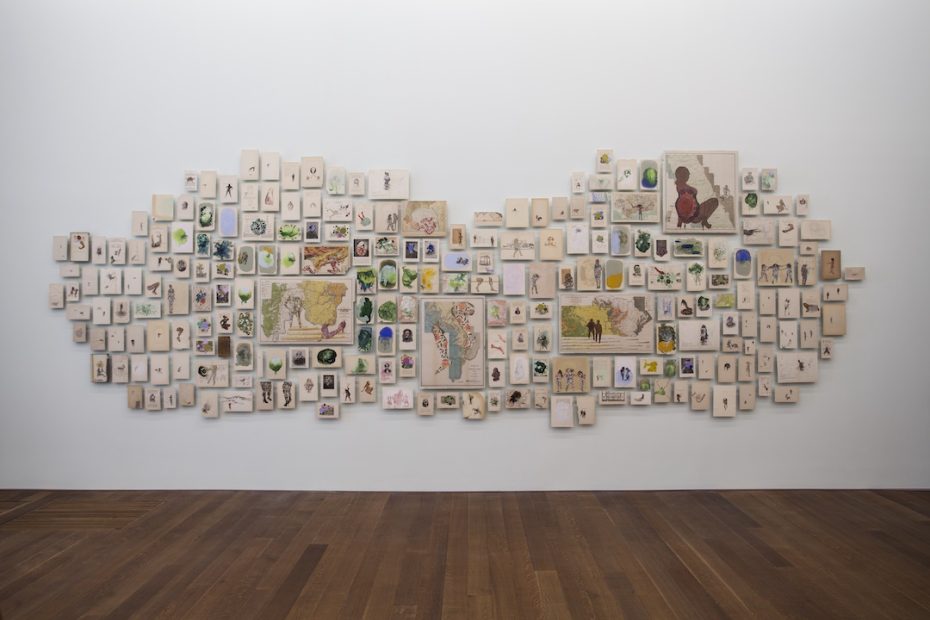
Inspired by the exhibition i’m yours: Encounters with Art in Our Times and artist Firelei Báez’s artwork, build and create a book that tells your unique story! What experiences have shaped who you are today? Dominican-American artist Firelei Báez explores and reimagines the histories of the land she is from. She draws pictures on top of history book pages to tell new ways of reading history, particularly of Caribbean, African, and Latin American cultures. Explore multimedia materials and collaging while creating pages for your story book.

This activity is designed for ages 8 and up, and is easy to adapt for younger ages. ​

Materials:

Icon of paper

Thick paper

Icon of scissors

Scissor

Icon of a glue stick

Glue stick

Icon of overlapping striped triangle, circle, and a flower.

Collage material


Icon of pencil

Drawing utensils

Icon representing cardboard

Optional: Thin cardboard or a cereal box

Steps:


ICAartlab_storyofme_STEP-1.png

1.
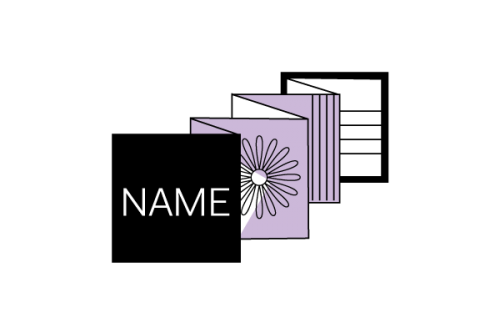
Cut and fold an accordion book. Using scissors cut your piece of paper in half length-wise to make two long skinny rectangles. Fold one rectangle in half widthwise. Fold the top flap in half again by bringing the outer edge to meet the center crease. Flip over and repeat with the opposite flap, creating a “W” shape with your paper. Repeat this with your second paper rectangle. Once folded, glue your two paper rectangles together by overlapping outermost flaps, creating one long zig-zag.


ICAartlab_storyofme_STEP-2.png

2.
Read, discuss, and reflect on the “Page Prompts” to get started on designing the pages of your story.
 

Icon of overlapping striped triangle, circle, and a flower.

3.
Unfold your accordion book and respond to the “Page Prompts” using collage materials and drawing utensils. Feel free to use the front and back sides of the paper. Cut, layer, and combine collage materials to tell your story and create a multimedia book. Multimedia means that a variety of materials are combined into a single artwork. 
 

ICAartlab_storyofme_STEP-4.png

4.
Flip through your book from beginning to end and add any finishing touches. Add a title if you would like. Sign your name and today’s date somewhere on your book.
 

ICAartlab_storyofme_STEP-5.png

5.
Share your story with family and friends! Read it out loud. Revisit it whenever you need a reminder of who you are.

 
TIPS!

  • For extra pizazz, create book covers by cutting out thin cardboard (cereal boxes work great!). Using a glue stick, glue each cover onto the outermost pages of the accordion-fold book.
  • Page prompts: Draw a jar full of your favorite things.
  • Draw something that represents the place your family comes from.
  • What is your proudest moment? What did it look like?
  • What is one thing you would do to help someone?
  • Or how has someone helped you? What is something about yourself that you would like others to know?
  • What does your future look like to you?
  • What are other ways you can tell your story with art materials?
     

Share your art with friends and family and on social media with #ICAArtLab or email us at familyprograms@icaboston.org.

Download PDF

Making a collage is a creative and fun way to tell a story. This project will inspire you to turn your ideas, thoughts, emotions, and dreams into images using pictures from old magazines. Get creative and use other materials collected from your home such as fabric or small objects. Let your creativity bloom and have fun!

This activity is designed for children ages 5 and up and their grownups to work on together at home.

Please note that this project involves using scissors to cut paper. 

Materials:

Icon of papers labeled

Zine

Icon of scissors

Scissors

Icon of glue stick and tape

Glue or tape

Icon of overlapping striped triangle, circle, and a flower.

Paper, fabric, and/or found objects


Steps:

ICAartlab_storycollage_STEP1.png

1. COLLAGING

is a process of combining and layering multiple images or pieces of materials together to create a single artwork. What story do you want to tell with your collage? Using scissors, cut out words, images, textures, and colors from old magazines that will tell your story


Art lab icons with striped yellow and pink geometric shapes, a flower, and text reading

2. ARRANGE AND LAYER

the magazine clippings until you find a connection between them and can build a story. Explore different options for a background for your collage. Will it be a solid color, a pattern, or a page of text?


Art lab icons with striped yellow and pink traingles, a flower, and text reading

3. COMPOSITION.

Once you have found an arrangement, or composition, that you like, glue or tape the magazine clippings onto the background of your choosing. 


Share your art with friends and family and on social media with #ICAArtLab or email us at familyprograms@icaboston.org.
In my role at the ICA I am responsible for the success of each performance from a technical and logistical standpoint. My colleagues and I work with each incoming performance, artist, and group to establish how to fit their show into our space (which includes looking at lighting, audio, special effects, and personnel) and how to do it on time, on budget, and in a safe way.

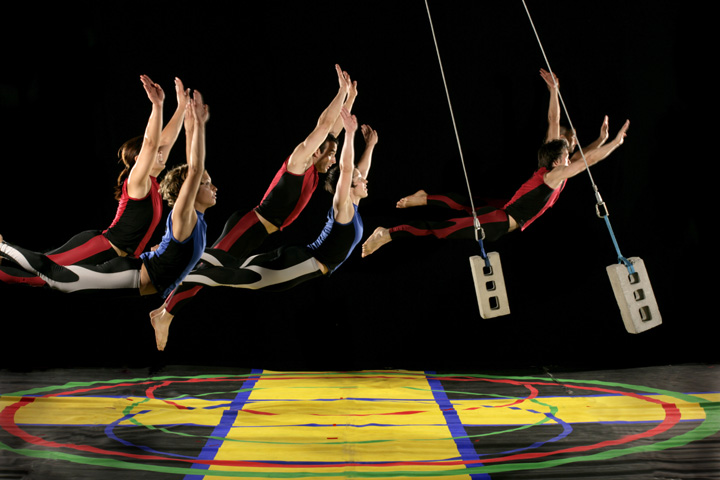
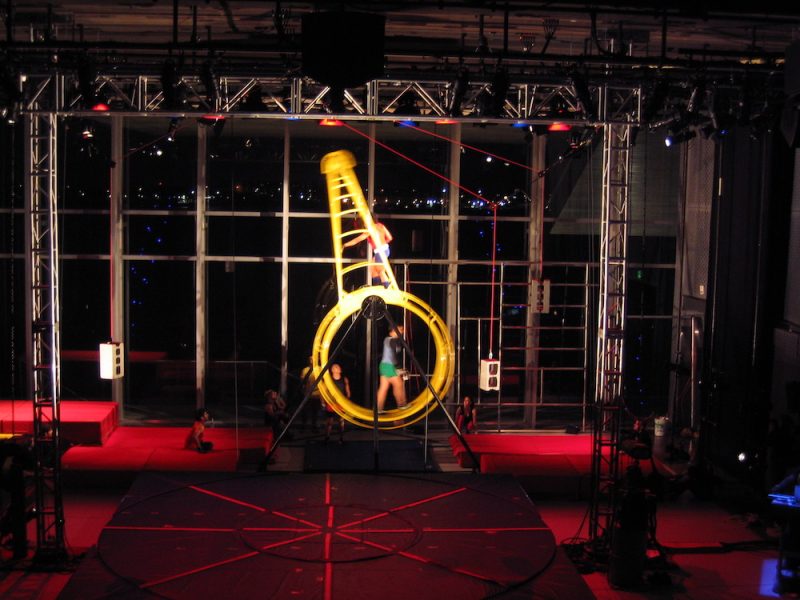
Elizabeth Streb, a self-described “action architect,” designs shows that are made to test the limits of safety, comfort, and physicality; through her decades as a choreographer, she has honed a technique that expands the athletic boundaries of dance and has trained her dancers to protect their bodies while executing what appear, at least, to be impossible feats. Still, a show like this makes someone like me lose sleep. How do you present something that looks incredibly dangerous without actually imperiling anyone?

I remember getting the plans for the Streb show in 2009. It’s a show that’s filled with large, potentially dangerous components: an enormous hamster wheel that people climb in, around, and on top of; swinging cinderblocks that dancers dive through; and a thick plexiglass wall that dancers literally splat into. How to fit these into our very new, very delicate, glass-walled space where you can’t attach to any surface was, to say the least, a challenge. It was a million questions for Elizabeth Streb, her design team, our facilities team, our engineers, and our lawyers. It was asking the silliest-sounding questions and then trying to explain the reasoning behind the question. It was pictures and diagrams and video links sent back and forth, and it was, at each junction, saying “….hmmm, ok, but what if we…”

In the end, we found ways to make all of the elements fit. We had to place the giant hamster wheel ever so carefully so that the dancers’ heads, when they stood on top of it, were up between the lighting pipes, and there was a height limit for dancers allowed on top. We had hundreds, if not a thousand, pounds of steel blocks weighting down the plexiglass wall, but we had to spread out the point load so as not to break the floor. We had ground-supported truss holding up the cinder blocks at just the right height so that the arc of the swinging cinderblocks was at the right pace, so that the dancers could execute their (very scary looking!) movement safely, as trained.

At the culmination of months of prep work and a week of installation, I sat watching the show, perched on the edge of my seat, white-knuckled, holding my breath, witnessing incredible athletes do impossible, and crazy, things. It was an amazing show that I was proud to be involved with, and happy to see go.

See Elizabeth Streb and her dancers at work in Born to Fly: Elizabeth Streb vs. Gravity, streaming through Feb 25. 


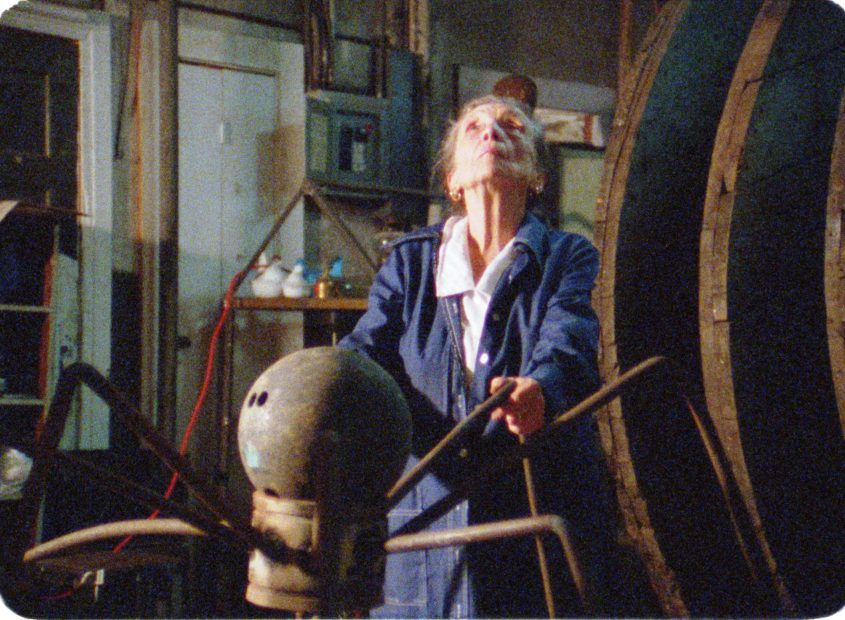
As I write this, I sit facing a small print by Louise Bourgeois that hangs in my home office. It is a blood-red flower with a bulbous bloom and four tendrils. Deceptively simple, it makes a strong statement – emotional, suggestive, graphic – and was a Christmas gift from Louise many, many years ago. As we make available to our audiences the documentary Louise Bourgeois: The Spider, the Mistress, and the Tangerine, I can’t help but remember the years I spent with Louise as her assistant, which always brings a smile to my face. My work with her began when I was a graduate student in New York and saw an index card pinned to the school bulletin board: “help wanted moving books.” I needed a job, so I called and went to interview at her 20th Street home in Chelsea. I had the charge of organizing Louise’s collection of books on all aspects of women’s work and her late husband’s library of art books. I was immensely happy immersed in all those books on her top floor. Gradually, with the libraries in hand, I moved down to the first floor, working alongside Louise as her personal assistant.

I hope you enjoy the film and the time spent on screen with this extraordinary woman and artist. She was full of spit and spirit, complexity and creativity, humor and hubris, and loyalty and love. 


Download PDF

Inspired by works from the ICA exhibition i’m yours: Encounters with Art in Our Times, check out these conversation starters to help inspire dialogue in your family. Print, cut out, and use them whenever you need some inspiration.

Visiting the ICA? Open on your mobile device, search for these works, and take turns asking questions as you move through the exhibition. Plan your visit


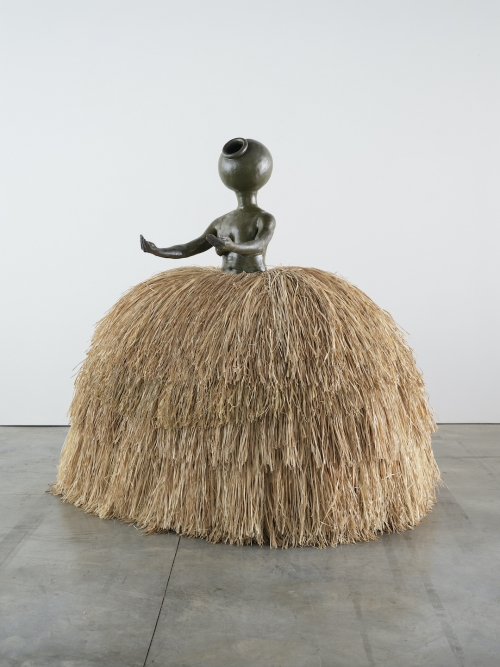
A sculpture of a woman stands with outstretched arms. She is nude from head to waist. The surface of the sculpture is rendered in varied dark tones, with mostly dark greens and browns, and is chipped and freckled in many places. She has no face. Her head is a round open bowl without eyes, nose, mouth, or ears. She wears a large, voluminous skirt. The skirt is made of dried raffia, which is a type of palm tree. She stands at life-size.

What do you do to show your friends and family that you care about them?


Simone Leigh, Cupboard IX, 2019.

Stoneware, steel, and raffia, 78 × 60 × 80 inches (198.1 × 152.4 × 203.2 cm). Acquired through the generosity of Bridgitt and Bruce Evans and Fotene Demoulas and Tom Coté. Courtesy the artist and Hauser & Wirth, New York and Los Angeles. © Simone Leigh 


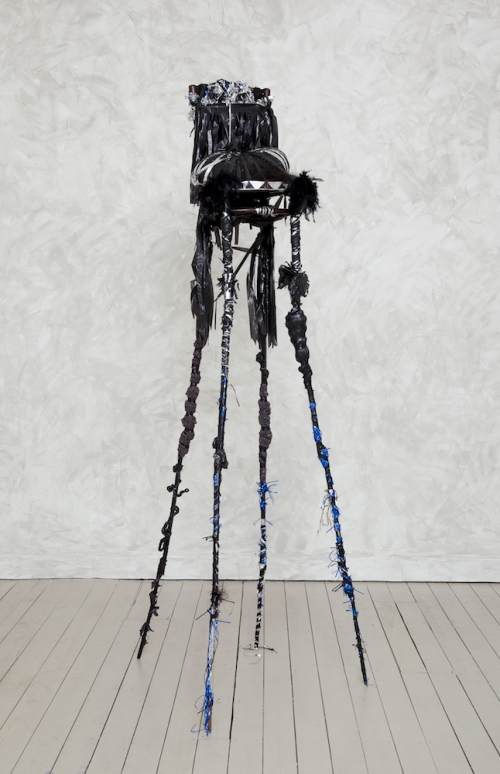
A sculpture comprised of a black wooden chair with elongated, spider-like legs that towers in height and is decorated with black feathers, black and silver tinsel, and hair.

If you made a throne for yourself, what would you make it out of?


Wangechi Mutu, Blackthrone VIII, 2012.

Wooden chair, plastic, hair, and tinsel. 100 ⅞ x 26 ⅞ x 39 ⅞ inches (256.2 x 68.3 x 101.3 cm). Gift of Jerome and Ellen Stern. Courtesy of the artist © Wangechi Mutu


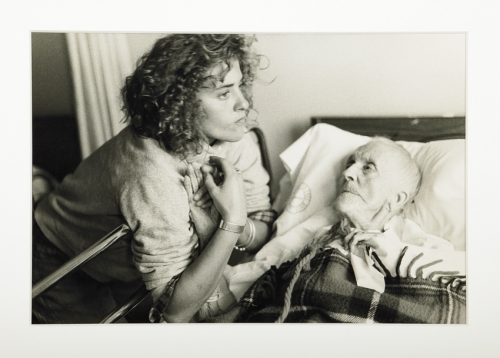
A black-and-white photograph of a light-skinned young woman leaning over the railing of a hospital bed, holding the hand of a frail and pale elderly woman who lays in the bed and looks up at her.

Describe a moment you had with your grandparent(s) that you remember really clearly. 

Nan Goldin, Chrissy with her 100-year-old Grandmother, Provincetown, 1977.

Gelatin silver print, 8 ½ × 11 inches (21.6 × 27.9 cm). Gift of Lillian and Hyman Goldin. Courtesy Matthew Marks Gallery. © Nan Goldin


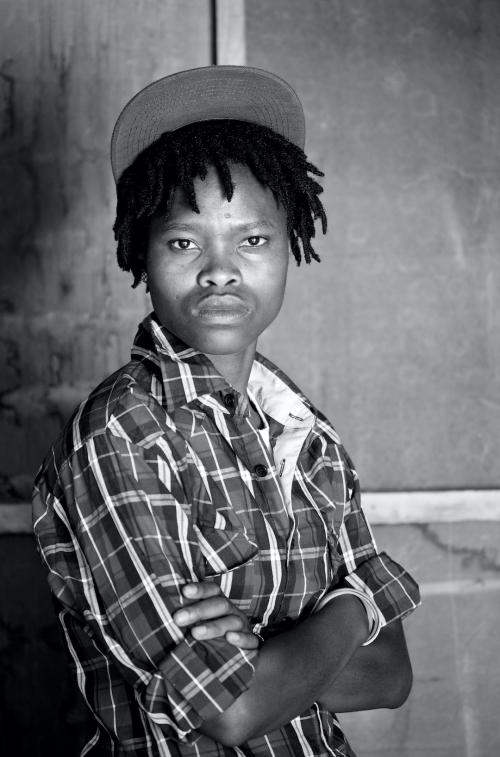
A black-and-white photograph of a person from the waist up wearing a cap and plaid button-up shirt

The artist asked the sitters to pick their clothing, the setting, and their posture. What would you choose if someone was making your portrait?

Zanele Muholi, Hlomela Msesele, Makhaza, Khayelitsha, Cape Town, 2011, from the series Faces and Phases (2006–ongoing).

Gelatin silver print, 34 × 24 inches (86.4 × 61 cm). Acquired through the generosity of the General Acquisition Fund and the Acquisitions Circle. Courtesy of the artist; Yancey Richardson, New York; and Stevenson, Cape Town and Johannesburg. © Zanele Muholi


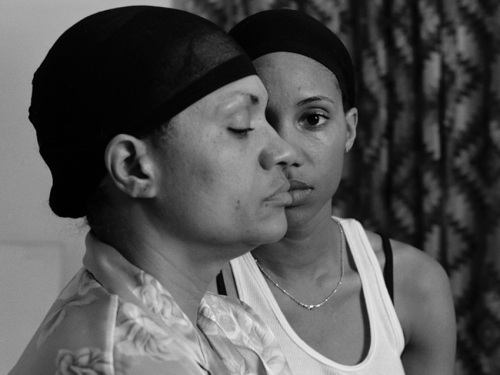
A black-and-white photograph shows the artist, a Black woman, looking directly at the viewer as she stands behind her mother, who is shown in profile and whose head obscures half of the artist's face. Both are wearing hair caps and a curtain is seen in the background.

Who is the family member you admire the most and why? If you were to take a photo with that family member, how would you pose?

LaToya Ruby Frazier, Momme, 2008.

Gelatin silver print, 30 × 40 inches (76.2 × 101.6 cm). Gift of the artist and Michel Rein, Paris/Brussels. Courtesy the artist and Michael Rein, Paris/Brussels. © LaToya Ruby Frazier


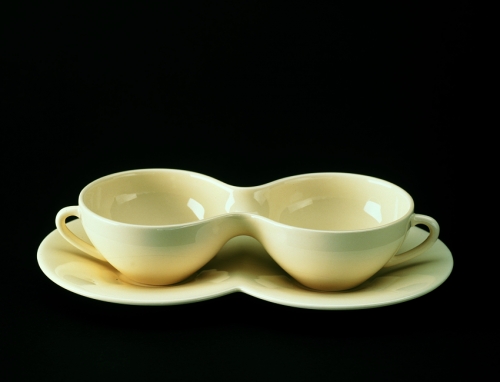
A sculpture of two glazed white teacups on matching saucers. The cups are fused together to appear conjoined, as are the saucers.

Let’s pretend we’re drinking from this cup together. How would we move our bodies and hold the cup to share what’s inside? 

Mona Hatoum, T42, 1993-1998.

Fine stoneware in 2 parts, 2 3/16 x 9 ½ x 5 ½ inches (5.7 x 24.1 x 14 cm). Gift of Barbara Lee, The Barbara Lee Collection of Art by Women. Courtesy Alexander and Bonin and White Cube. Photo by Iain Dickens. © Mona Hatoum 


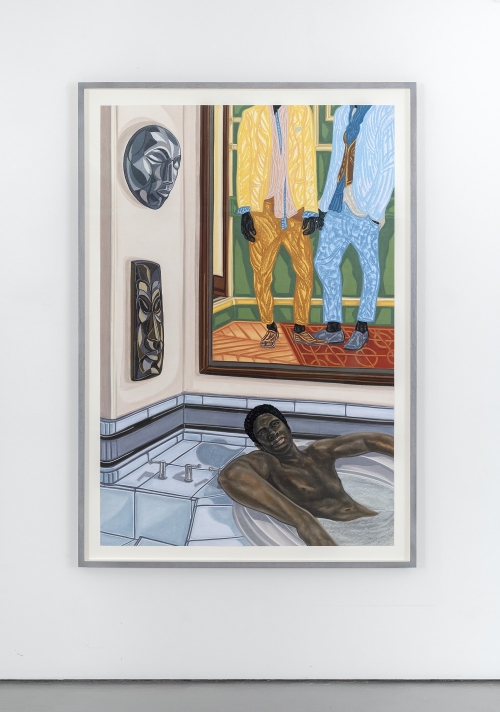
A drawing on paper depicts a Black man relaxing in a tiled bathtub with art objects including two masks and a rendering of two Black men in colorful suits hanging on adjacent walls behind the tub.

What do you like to do to relax? 


Toyin Ojih Odutola, Heir Apparent, 2018.

Pastel, charcoal, and pencil on paper, 63 ¼ x 42 inches (160.7 x 106.7 cm). Acquired through the generosity of the Acquisitions Circle. © Toyin Ojih Odutola


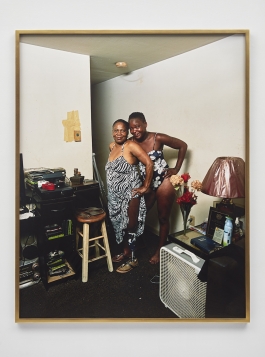
A color photograph shows two Black women posing together in cluttered living space. One raises her zebra-print dress to expose a prosthetic leg. The other is in a floral swimsuit. Both have their hair pulled back and smile toward the viewer.

The objects found in homes can give clues about the people who live there. What is an object in your home that might give a clue about who you are and what or who is important to you?


Deana Lawson, Barbara and Mother, 2017.

Pigmented inkjet print, 69 × 55 inches (175.3 × 139.7 cm). General Acquisition Fund. © Deana Lawson


This activity was developed by Amy Briggs Kemeza, Tour Programs Manager; Flolynda Jean, Education Assistant, Studio Programs; Jessie Miyu Magyar, School and Family Programs Manager; Brooke Scibelli, Family and Art Lab Programs Coordinator; and Kris Wilton, Director of Creative Content and Digital Engagement.

Download PDF / Descargar PDF

Welcome to our process. We live intentionally and document creatively. Let’s pay attention, not just to how we eat, but to the process we must go through to get there—then write about it afterwards.

Bienvenido a nuestro proceso. Vivimos intencionalmente y documentamos con creatividad. Prestemos atención, no solo a cómo comemos, sino también al proceso que seguimos para lograrlo. Después escribamos sobre esto.

Materials/Materiales: 

  • Fruit you can peel / Frutas que se puedan pelar
  • Something to write on/with / Algo para escribir
  • Time set aside to be present with the activity / Tiempo aparte para estar presente en la actividad

Instructions:

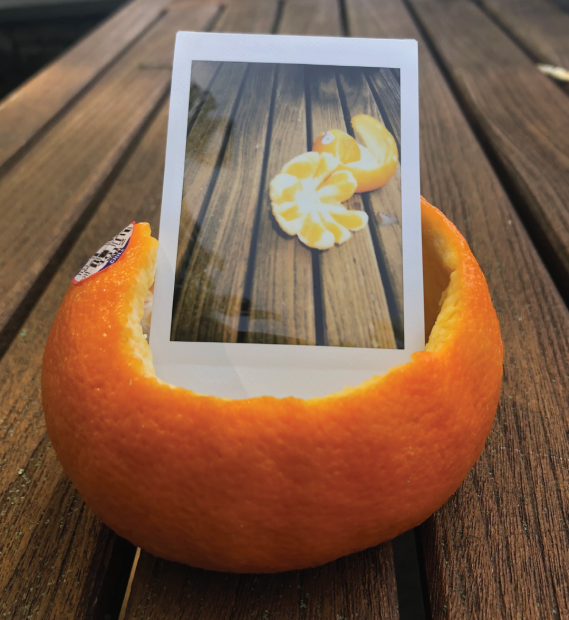
1. Pick a fruit you would eat that you can also peel with your hands

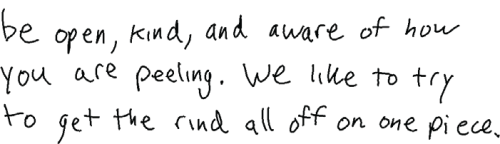
Handwritten script that reads

2. Peel your fruit while paying close attention to how you do it.

Handwritten script that reads

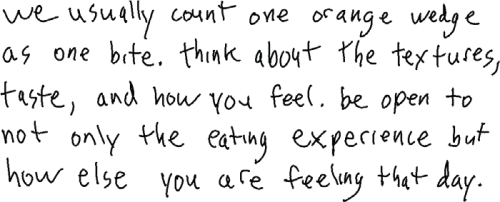
3. Take five intentional bites.

Handwritten script that reads

Creative Documentation:

Now write. Use any thoughts or feelings you had during the experience of peeling and eating. What if the process was more than just about food? What is peeling a metaphor for in your life?

Bonus Challenge: Find another way to document the process

  • Take a photo
  • Make a drawing
  • Turn your peel into a superhero
  • Record yourself
     

Instrucciones:

1. Elige una fruta que te gustaría comer y que también puedas pelar con las manos.

Handwritten script in Spanish that reads

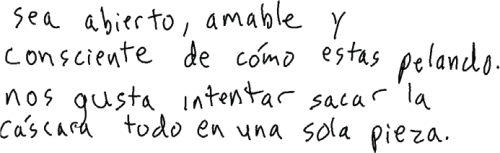
2. Pela la fruta prestando mucha atención a cómo lo haces.

Handwritten script in Spanish that reads

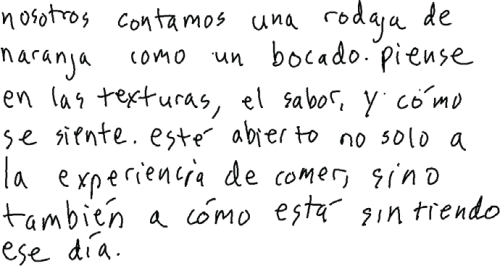
3. Come cinco bocados con intención.

Handwritten script in Spanish that reads

Documentación creativa:

Ahora escribe. Anota los pensamientos o las emociones que surgieron durante la experiencia de pelar y comer. ¿Acaso el proceso tuvo que ver con algo más que la comida? ¿En qué sentido pelar la fruta es una metáfora de tu vida?

Desafío adicional: Busca otra manera de documentar el proceso

  • Saca una fotografía
  • Haz un dibujo
  • Convierte la cáscara en un superhéroe
  • Graba un video o un mensaje de voz
     

A Puerto Rican and a Cambodian walk into a kitchen. The kitchen is your heart. The food is made with food. The food is sometimes poems. Either way you are fed. Adobo-FishSauce (Anthony Febo, Ricky Orng) began as an artist project fusing live cooking and spoken word poetry performances as a means to invite the audience into an enhanced storytelling experience. Now as they develop new projects, they continue to explore new recipes for collaboration.

Un puertorriqueño y un camboyano entran a una cocina. La cocina es tu corazón. Los alimentos se preparan con alimentos. A veces, los alimentos son poemas. Ambos te alimentan. Adobo-Fish-Sauce (Anthony Febo, Ricky Orng) comenzó como un proyecto artístico que fusiona la cocina en vivo con la palabra hablada de los recitales de poesía como un medio para invitar a la audiencia a una mejor experiencia narrativa. Ahora, a medida que ellos desarrollan proyectos nuevos, siguen explorando novedosas recetas en conjunto.


Look out for @adobofishsauce on IG and join us for #goneslinging — an intentional walk and talk. Share your artwork with us at #peelingpoems Find more about AFS at adobofishsauce.com.

Busca @adobofishsauce en IG y participa con nosotros en #goneslinging, una caminata y una charla con intención. Comparte tu obra de arte con nosotros en #peelingpoems. Obtén más información sobre AFS en adobofishsauce.com.